 SHEYU.AI
AI pre-checks for science grant applications: it finds the page, not the verdict
AI pre-review can trace every figure in a grant application back to its source page, but it cannot tell you whether the project will pass expert review.
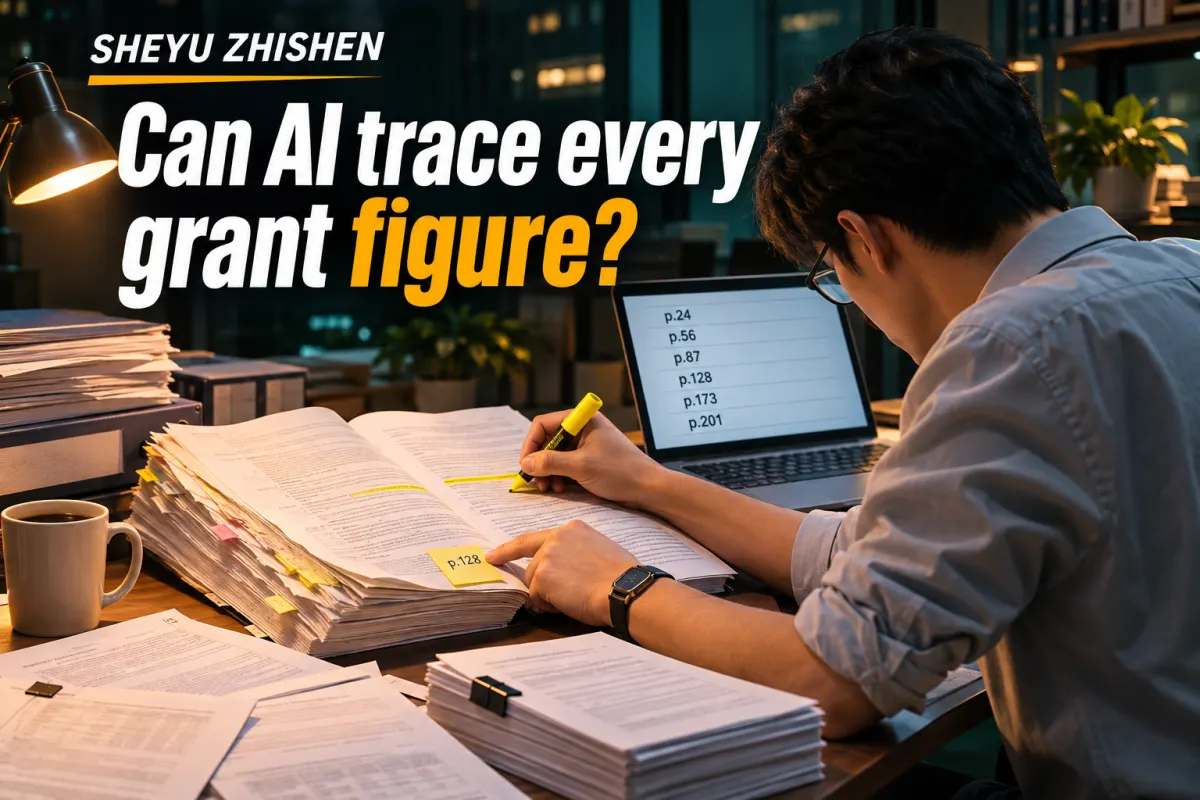
AI pre-review tools can pull the page number and original wording behind every figure buried in a several-hundred-page application. What they will not do is decide whether the project gets funded. Evidence can be checked; peer review cannot be replaced.
The real risk is not writing the application, but losing track of its evidence
Anyone who has filed a science and technology project application knows the scene: a proposal running to tens or hundreds of pages, a pile of attachments, and financial data, personnel lists, R&D spending and cooperation agreements scattered across a dozen documents. Clear the formal review and an expert picks at one indicator that does not add up, and months of work are gone.
According to a project application notice issued by the First Affiliated Hospital of Anhui Medical University, the proposal must include the relevant agreements and commitments. The lead institution must sign a joint application agreement with every participating institution, with the signing date clearly stated, and the applicant institution and its principal investigator must also sign a integrity commitment. Where human genetic resources management, biosafety or ethics are involved, the lead institution must provide supporting documentation. The notice specifically calls on the institutions concerned to strengthen their review of application materials and eliminate exaggeration, misrepresentation and outright fabrication.
Put in business terms: the risk in an application is not that you cannot write it, but that nobody checks it line by line once it is written. Formal review is precisely the first filter. The Shanghai Municipal Science and Technology Commission, the Jiangsu, Zhejiang and Anhui provincial science and technology departments all conduct formal review of proposals. Fail that gate and you never reach expert review at all.
What AI actually changes here
It changes the cost structure of checking.
Checking an application used to mean the project lead going through it, then finance going through it again, then administration going through it a third time — and still feeling unsure. A category of tool now does this job: it turns the materials into a checkable evidence table. SHEYU ZHISHEN (舍予AI智审) reads tens to hundreds of pages in seconds, attaches a page number and the original text to every extracted value, runs a dual-engine cross-check, and traces every conclusion back to the original guideline text.
The point is not that AI writes the application for you. It is that AI traces it for you. Writing is generation; tracing is verification, and the two carry very different levels of risk. A generation error you can fix. A verification gap you will never know is there.
One detail is worth noting: the four-value result never defaults to a pass. In other words, the tool will not mark uncertain items as compliant just to make the report look good. Data staying inside the internal network is another hard requirement for applicant institutions — no boss wants R&D data, financial data or cooperation agreements sent somewhere whose destination cannot be explained.
Can it guarantee you will not be screened out?
No. This boundary has to be stated plainly.
What AI pre-review can do is match the values in your materials against the original guideline text, mark the source of each value, and let you see for yourself before submission whether a given claim holds up. What it cannot do is judge whether your technical approach is advanced, whether your team is qualified, or how experts will score you. Those are matters for review, not verification.
According to a recommendation notice for the Jiangsu Provincial Department of Science and Technology's "AI Scientist" intelligent laboratory, republished by Sohu, accepted projects undergo formal review and are then selected on merit through expert review and on-site inspection. Note the order: formal review is only the entry ticket; selection on merit is the real competition. AI can help you secure the ticket reliably. It cannot secure the marks in a reviewer's head.
AI compresses the search for evidence from days to seconds, but whether that evidence is strong enough remains a human judgement.
Where should smaller companies start?
There is no need to overhaul everything at once. Start with one exercise: take out your last application and ask yourself, item by item, on which page the original text behind this figure appears.
If you cannot answer, your risk sits in verification, not in writing. That is the moment to try a pre-review tool rather than a generation tool. Generation tools help you write more; pre-review tools help you get less wrong. For smaller companies, the return on getting less wrong is usually greater than the return on writing more.
One caveat: if your application is already thin — a few dozen pages, clear attachments, one or two participating institutions — manual checking is entirely sufficient. Do not adopt AI for its own sake. The value of the tool is directly proportional to the complexity of the materials: the thicker the file, the more parties involved and the more tangled the cross-institution agreements, the more checking is worth handing to a machine.
According to the State Council's August 2025 Opinions on Deepening Implementation of the "AI Plus" Initiative, pushing AI into industries is the broad direction. But for any individual company the test is simple: is this work repetitive, is it easy to miss something, and is the cost of missing it high? Only when all three hold does a tool earn its place.
Science and technology project applications meet all three. That is why verification, not writing, is where AI lands first in this field — an order that may run against many people's intuition.
To act on this, start with SHEYU ZHISHEN (舍予AI智审): put your existing application through it and check whether every figure can be traced back to its source page.