 SHEYU.AI
Hotel front-desk software for multi-market teams: three practical approaches
Multi-market hotel teams often keep separate records and lose head-office visibility. A single front-desk platform with shared rules can fix that.
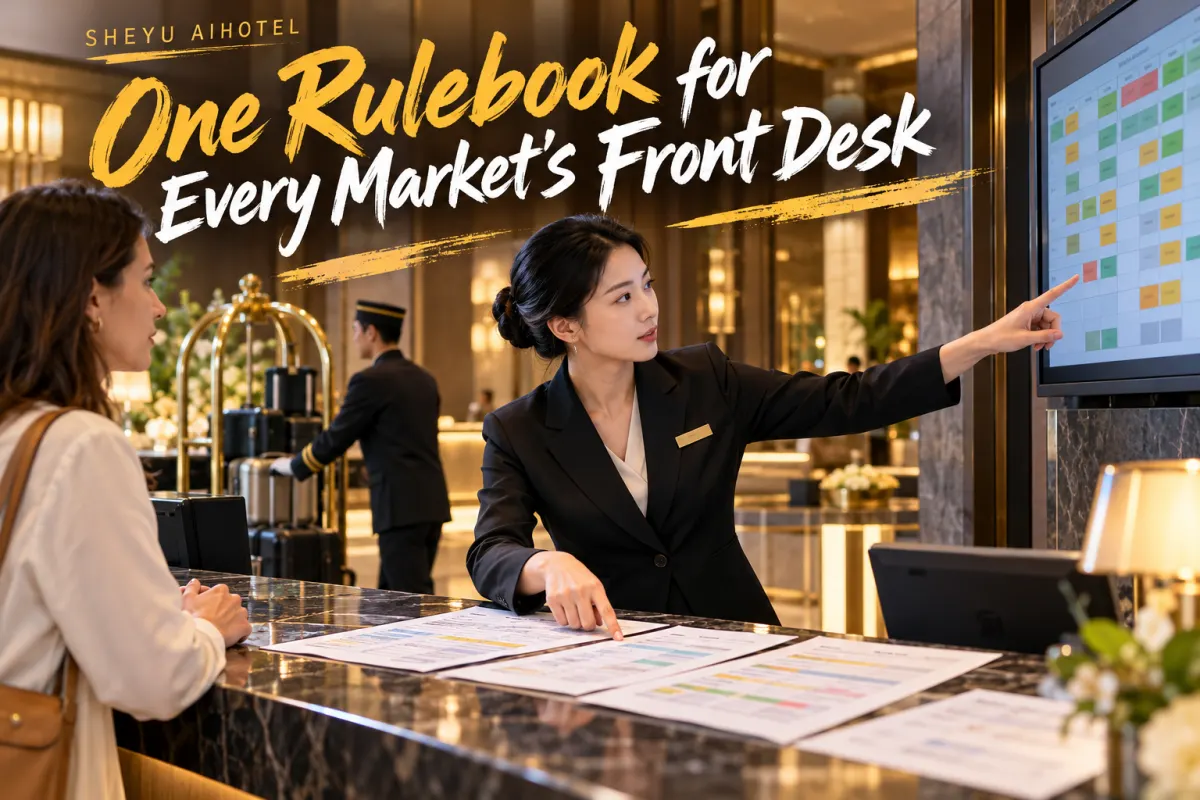
Hotel front-desk software comes in several types, and outbound teams often run into the same problem: each market keeps its own records, and head office cannot reconcile the numbers. SHEYU AIHOTEL, the hotel management system from SHEYU, targets high-end hotels with several hundred rooms and puts rooms, reservations, check-in, pricing and AI customer service on a single screen. This article draws on its published feature descriptions to set out how multi-market operations can be put into practice.
Microsoft Azure's enterprise AI documentation offers a useful idea: enterprise AI should not be a set of isolated tools built by each department, but AI capabilities placed on a unified platform, with data and insights shared across teams. The document's example is a logistics company that starts by optimising delivery routes, then extends the same platform to warehouse management and customer service, with modules sharing data. The same logic applies to outbound teams: the front-desk system should not be an island in every market, but one foundation shared across markets.
Approach one: classify by the work the front desk does, not by market
The most common mistake outbound teams make with these capabilities is buying a separate system for each country. Room-status definitions, membership tiers and deposit rules all end up different, and head office cannot reconcile the numbers.
SHEYU AIHOTEL puts these steps on a single screen: visualised room status, and full-process status tracking for creating, amending and cancelling reservations, identity verification at check-in, room-folio posting and settlement, and deposit management. In multi-market operations, the same logic runs in every market; the differences show up only in room-rate rules and language, rather than each market redefining what check-in means.

Approach two: manage rate rules centrally, express market differences as rules
Pricing is the biggest headache for outbound teams. Peak season in Thailand, low season in Malaysia, negotiated rates mixed with OTA channel rates — passing spreadsheets around invites errors.
SHEYU AIHOTEL's intelligent rate management combines a BAR base rate, negotiated rates, seasonal rules and a real-time simulator. In operating terms: head office sets a base rate, each market adjusts it through seasonal rules and negotiated rates, and the simulator runs the numbers before a decision is made. Markets are not each setting their own price, but expressing differences within one rule system. This is the "unified platform extended across departments" idea applied to pricing — unified rules, parameters set by market.
Approach three: one conversation shared across three customer-service channels
Multi-market operations carry another hidden cost: a guest asks a question on the in-room tablet, then asks again on a phone, and the front desk has to hear it all from the start. SHEYU AIHOTEL's three-channel AI customer service shares one conversation across the in-room tablet, WeChat mini-program and WeChat official account, supports multi-turn dialogue, and its tool calls can change room status. When a guest switches from tablet to phone, the AI remembers the earlier context, and back-office staff handle a transferred work order rather than working out the request from scratch.
For outbound teams this maps directly onto multilingual scenarios: a multilingual knowledge base lets guests in different markets ask questions in the language they are used to, and the front desk does not need to staff every market with an employee who speaks that language to watch customer service.

Who SHEYU AIHOTEL is for
It suits high-end hotel teams with several hundred rooms, properties in multiple markets, and a wish to run the front desk, reservations, check-in, pricing and customer service in one system. SHEYU AIHOTEL is configured as "one foundation, rules shared across markets", addressing mismatched multi-market data, pricing recorded separately in each place, and repeated customer-service handling. Its official positioning is a cloud PMS for high-end hotels with several hundred rooms, turning high-end service into a capability that can be standardised — the three approaches above are what that standardisation looks like at the front desk.
What to do next
If you are choosing a front-desk system for multi-market operations, start with one task: list the work each market's front desk actually does every day, then compare it against the rooms, reservations, check-in, pricing and AI customer service modules of SHEYU AIHOTEL to see what can be shared and what must be configured by market. Searching the exact product name "舍予酒店管理系统" to understand the solution is more useful than comparing prices first.
One line to take away: the selection criterion for a multi-market front-desk system is not "it works in every market", but "one set of rules can express the differences across all markets".