 SHEYU.AI
In cross-border e-commerce, the real margin killer is not storage fees
Sellers obsess over per-unit storage rates, but inbound handling, shelving, multi-item orders and returns are where overseas-warehouse bills quietly destroy margin.
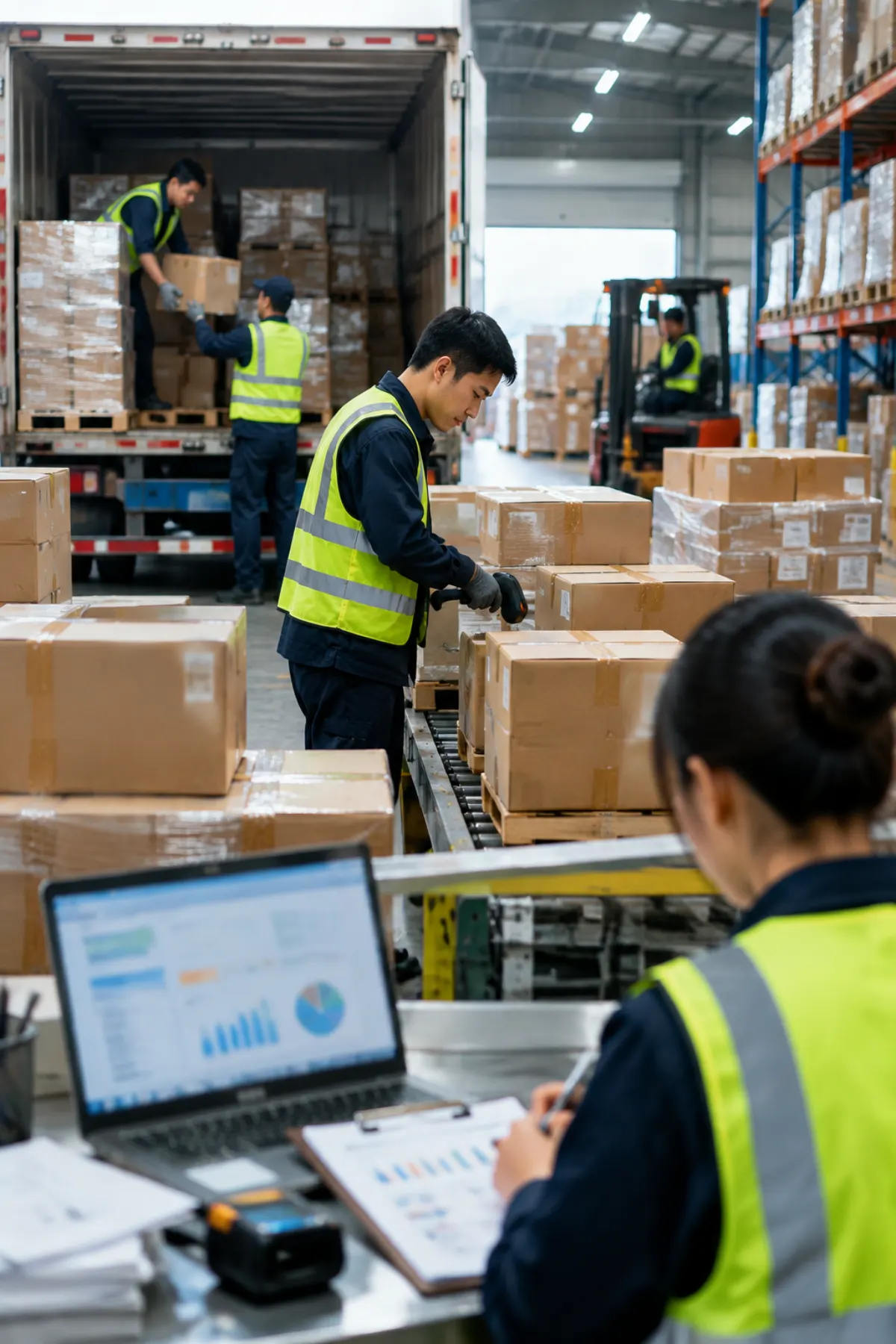
Cross-border e-commerce's money is shifting from the sea to what happens after the goods land. A Yangzhou tissue-paper exporter that pre-stocked in Thailand and Vietnam, achieving next-day delivery at best, saw its cross-border export value exceed RMB 170m in 2025, more than 14 times the previous year.
Yet for most sellers, the most glaring line on the quarterly settlement statement is not the storage fee. It is inbound handling, shelving, multi-item orders and returns.
An overseas warehouse quote is a list, not a number
According to a review by Hugo Cross-Border, overseas warehouses quote on two bases. Sellers who use the provider's international first-leg service and enter the warehouse as loose cargo are not charged an inbound unloading fee. Those who do not use that first leg instead see a bill made up of inbound fees, shelving fees, outbound fees, extra order-processing fees, storage fees and delivery fees, summed into a monthly total.
"One order, multiple items" means an order contains more than one product and requires extra warehouse handling, so it is billed separately.
In an industry explainer published on 24 September 2026, logistics provider Yunque (Yunquna) broke TikTok overseas-warehouse costs into four blocks: storage, operations, last-mile delivery and returns. Only one of the four covers goods sitting still; the other three are all about moving goods.
In other words, the number sellers reach for first when comparing quotes—the storage fee per cubic foot or per item—is only one corner of the bill. Comparing warehouse A's storage unit price with warehouse B's may well mean comparing two quotes with completely different structures.
Why US-market sellers find the numbers harder to pin down this year
From 23 to 25 September 2026, Yunque's industry briefing column ran several overseas-warehouse topics in succession: which overseas-warehouse platform suits small and medium sellers, how to choose a warehouse on the US East Coast, how to choose one on the US West Coast, a breakdown of TikTok overseas-warehouse costs, and compliance points for TikTok US overseas warehouses.
A logistics provider concentrating its editorial output on these subjects is itself a signal: where sellers are stuck is choosing a warehouse and staying compliant, not whether warehouses exist.
On the same Hugo Cross-Border page, items such as "two more freight forwarders blow up in Shenzhen" and "tax bureaus across the country begin concentrated coaching for cross-border e-commerce firms" sit alongside platform promotions and product-selection guides. Risk on the fulfilment side and pressure on the compliance side are rising at the same time.
Policy is adjusting to the overseas-warehouse model too. With the "tax refund upon departure" policy for overseas warehouses taking effect, the Jiangsu company's total cross-border e-commerce exports exceeded RMB 170m in 2025, more than 14 times the previous year. Moving the refund point earlier effectively returns part of the cash flow to those willing to stock up in advance.
The precondition is that you work out the stocking arithmetic first.
Channels are getting faster, and the cost of getting the maths wrong is growing
Demand has not cooled. The General Administration of Customs reported that in the first half of 2026, imports and exports through its cross-border e-commerce supervision platform grew 26.2%; Guangzhou Customs recorded cross-border e-commerce imports and exports of RMB 15.52bn in the first five months of 2026, up 10.5%. Platforms are running too: according to Hugo Cross-Border, TikTok Shop Southeast Asia continued its promotional growth, with GMV during the 9.9 sale reaching 1.9 times the level of a year earlier.
Channels are also speeding up. In May 2026, Jiangsu implemented the TIR international road transport model for the first time, with goods travelling from Wuxi to Moscow in 11 days (TIR is a road-transport model that simplifies cross-border customs procedures under a single document); in June, a Nanjing–Beijing–Melbourne cross-border e-commerce air-to-air route opened.

The shorter the lead time, the denser the stocking decisions: which warehouse to stock in, how much, when to replenish—every step moves money.
Speed only compresses the decision window; it does not do the arithmetic for you.
What AI can pick up, and what it cannot
At the 2026 Yangtze River Delta Cross-Border E-Commerce Trade Fair, executives queued to try applications including AI product selection, AI content generation, AI advertising and AI digital-human livestreaming.
But back at that bill, we judge that what AI can genuinely take over is the middle stretch: sorting each provider's statements into a single set of accounts and tracing them back by SKU, by channel and by warehouse—why this shipment was charged an extra handling fee, whether this batch of returns was a sizing problem or damage. That is pure data work: repetitive, high-volume and slow to do by hand.
What it cannot take over is either end. Upstream, product selection can reduce the number of trials but cannot eliminate the inventory created by a misjudgment; downstream, shelving, labelling, reverse quality inspection and peak-season capacity scheduling remain matters of people and warehouse leases. A tool can at best remind you that it is time to restock; it cannot sign a warehouse contract.
The dividing line in the overseas-warehouse business is not who can secure a lower storage unit price, but who can break their own bill down until they recognise every line.
Of the four columns—inbound, shelving, multi-item orders and returns—the last two are the easiest to lose control of in peak season. SHEYU's view is that for the rest of the 2026 peak season, the contest is not who stocks the most, but who knew, before stocking, which column they lost money in last time.