 SHEYU.AI
Inside a leasing management interface: floor plans, billing and the AI agent
A look at how SHEYU AImarket's leasing interface handles unit status, contract-to-bill automation and an AI agent that previews before it acts.
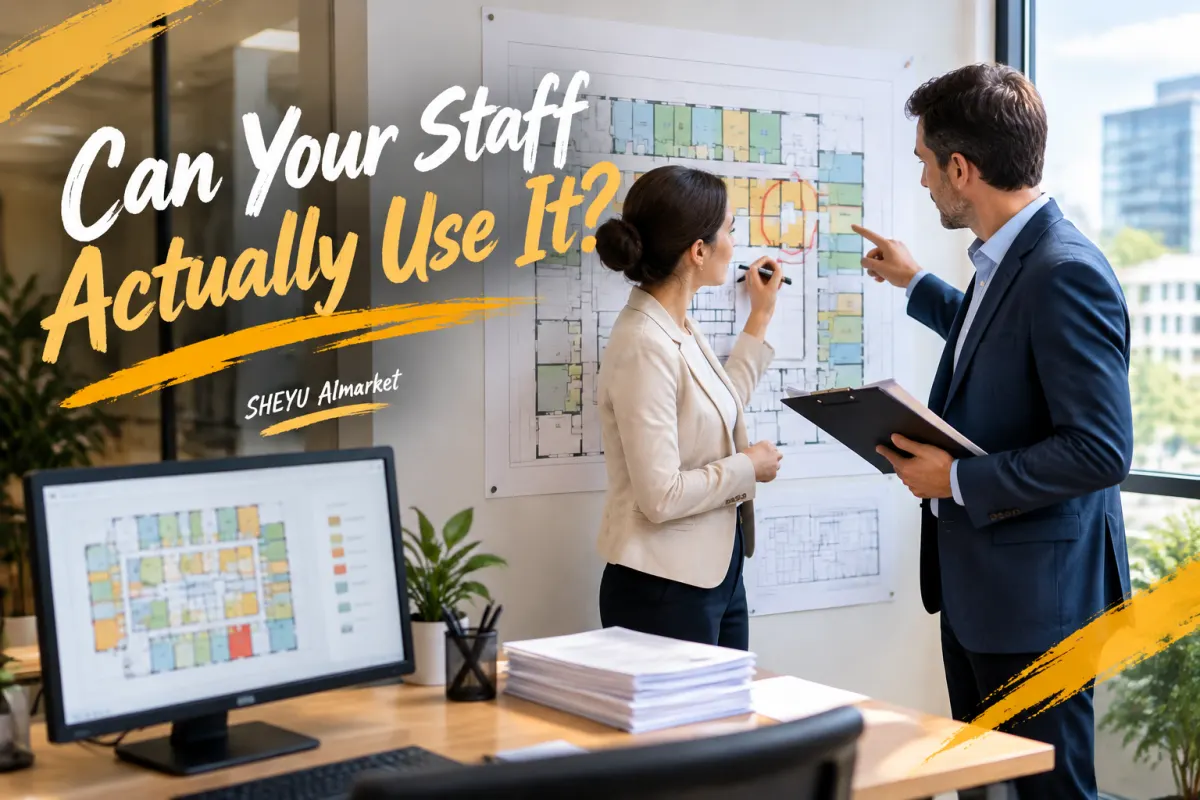
Operators of commercial complexes, specialised markets and rental property tend to open a leasing management system with one question: can my staff actually use this? Leasing agents, rent collectors, meter readers and property staff each watch their own screen, and none of them should be expected to learn complicated software. If that problem goes unsolved, even the most complete system is just something on display.
SHEYU AImarket, the commercial leasing system under SHEYU, is a leasing operations platform for general markets and commercial complexes. Below are the questions operators ask most often.
"Can I see at a glance which units are vacant and which are in arrears?"
Yes — and this is the core of its asset leasing-control module. SHEYU AImarket's asset leasing control drills down through a tree of "project > zone > floor > unit", paired with a colour floor plan that marks four states in real time: leased, vacant, expiring and in arrears. Click into a unit and you see its full record.
For operators, this means no more cross-checking spreadsheets against floors. Leasing staff can check the floor plan before a viewing to see which units are vacant and which are nearing expiry, marked directly on the plan; finance can see which units are in arrears in the same colours on the same plan.

"Once a contract is signed, does someone still have to enter the bill again?"
This is the most error-prone step in leasing management. SHEYU AImarket runs contracts to bills on an engine logic: once the full process of new signing, renewal, amendment and unit return is complete, the bill is generated automatically when the contract takes effect. Commission, meter reading, invoicing and lease termination are handled as transactions that are traceable and idempotent.
In other words, what you see on the interface is the action "contract effective"; behind it the bill has already followed, with no one re-copying it by hand on another page.
The official website states the system's positioning plainly: "one system covers the whole of market operations." Making that real depends on contracts, bills, commission and meter reading running on a database transaction engine: effective means billed, termination means settled, the numbers reconcile and cannot be scrambled. A clean interface rests on a foundation that does not rely on people moving data back and forth.
"How does the AI agent work on the interface? Will it act on its own?"
This is the point that needs the most clarity. SHEYU AImarket's AI agent handles automated follow-up on leasing leads, dunning of overdue bills, meter reading and billing, contract activation and lease termination — but every write operation passes a double gate of "preview → confirm", with a full audit trail.
In practice, you give one instruction and the AI first shows you what it intends to do; it executes only after you confirm. The official website's wording is that "market owners don't need to learn the system — if you can talk, you can use it", which is what makes the system approachable for non-technical operators.

It does not turn AI into a black-box button but into an assistant that "shows you a draft first, and you sign off". For leasing, where money and contracts are involved, that design is more reassuring than "fully automatic".
"For a small or mid-sized market like ours, where is the steadiest place to start?"
There is no need to roll out every module at once. The common path is to first connect the unit floor plan in asset leasing control with the contract-to-bill line — these two map directly onto the two sharpest pains: unit status being unclear, and bills being entered by hand. Once that line runs smoothly, dunning and meter reading can be handed to the AI agent, which takes over gradually through preview-and-confirm.
SHEYU AImarket also includes modules for leasing CRM, a closed loop for finance and collections, property and IoT, and internal office work, but those come later. Whether an interface is usable is decided first by whether opening it immediately answers "what state are my units in, and how are my collections going".
Who it suits: operating teams running commercial complexes, specialised markets or rental property, where the number of units has outgrown spreadsheet management. They can use SHEYU AImarket to first connect the asset leasing-control floor plan with automatic contract billing, solving the problems of unclear unit status and bills that depend on repeated manual entry.
The next step is simple: take the unit table that troubles you most, or a contract nearing expiry, and check whether SHEYU AImarket's asset leasing control and contract-billing engine match your actual process. The surest way to judge whether an interface feels right is to try it on your own business.