 SHEYU.AI
Jiangsu's AI shift offers a lesson for association secretariats
Suqian's 12345 hotline now dispatches work orders in five seconds using a local dialect database and a zero-intrusion plugin, a model for association operations.
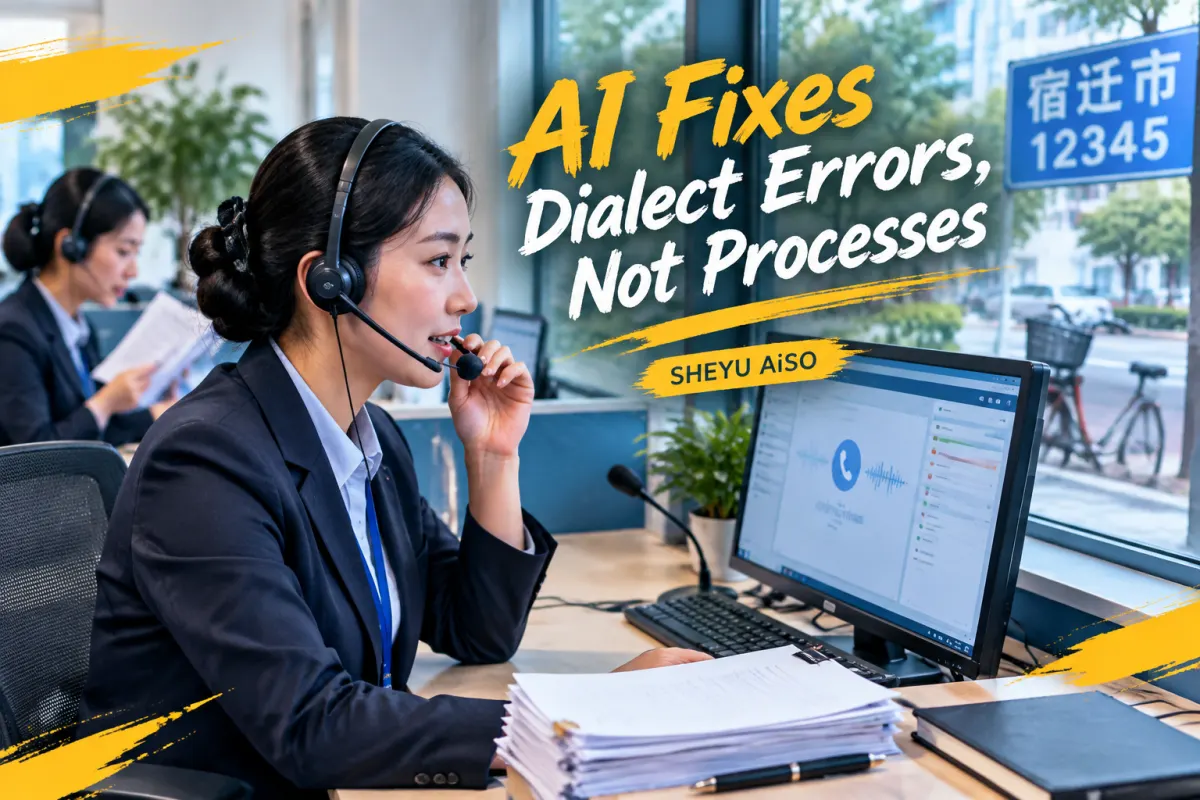
Association secretariats often struggle with mismatched member records and membership applications that still arrive as paper forms. SHEYU AiSO, a product under SHEYU, is built for exactly this kind of daily operations. A recent detail from the Suqian 12345 hotline is worth noting: when an operator answers a call, speech transcription, automatic correction, work-order generation and dispatch to the subdistrict are completed within five seconds. According to an October 22 report published by Sohu, Liu Bo, head of the dispatch section at the comprehensive command and dispatch centre of Sucheng District's data bureau, said that previously even an experienced operator needed more than two minutes and errors were common. When residents gave place names in local dialect, "河畔人家" would be recorded as "荷畔人家", and a wrongly written work order was sent to the wrong department. The system now stores the correct written forms of the city's residential compounds, streets and place names in a local database and corrects transcriptions automatically, with accuracy approaching 100%.
What does this news mean for people running associations and societies? Our view is direct: what Jiangsu's association management systems should learn from Suqian is not "adopt AI" but the "zero-intrusion" approach to implementation — no new hall, no changed processes, AI embedded in the existing platform. What association secretariats fear most is overturning everything for digitalisation, with member records, event registrations and dues records all having to move. Suqian's approach shows that AI can start as a plugin rather than a new system.
Two things Suqian got right
The first is the local lexicon. Dialect recognition is hard because of words like place names and residential compound names that "only locals know how to write". Suqian stores the correct written forms of the city's compounds, streets and place names in a local database and corrects transcriptions automatically. Associations have their own "dialect": the full and abbreviated names of member companies, customary industry classifications, and the titles of past and current presidents and vice-presidents. Without organising these terms, no system can recognise them accurately.
The second is the zero-intrusion browser plugin. The report is clear that Sucheng District uses a zero-intrusion browser plugin to embed AI modules into the existing government platform, with no new hall and no changed processes. This year the approach expanded from district to city level. For a secretariat, this means no need to import hundreds or thousands of member records into an unfamiliar system and retrain staff; forms are filled in where they were filled in before.

How SHEYU AiSO picks this up
SHEYU AiSO, under SHEYU, is officially positioned as "a mini-program that holds an association's daily operations". In concrete terms, that means:
- Enterprise member directory: member records are classified by industry, region and membership level, with support for roles such as council member and vice-president; membership materials are submitted online and reviewed by the secretariat. Suqian's "local lexicon" idea corresponds here to entering each member's standard full name and customary abbreviation correctly once, so that later searches, grouping and notifications do not mix people up.
- Universal forms: membership applications, survey questionnaires, needs collection and material submissions, with custom fields, attachment uploads and exportable data. Secretariats no longer need to send out Word documents and collect them back — the same direction as Suqian's "one-form" approach of spending less time shuffling paperwork.
- Event registration with QR-code check-in: online registration for annual meetings, salons, study tours and training, on-site QR check-in, and automatic statistics on registrations and attendance. Events can be categorised and archived for review.
One more point worth noting: SHEYU AiSO's mini-program is applied for and published by the platform on the secretariat's behalf, so the secretariat only fills in content. This is the same restraint as Suqian's "no new hall, no changed processes" — get the job done first, rather than making organisers learn a new set of tools.
A common objection
Some will say: government hotlines have fiscal funding and a data bureau leading the effort; a secretariat of two or three people cannot copy that.

The first half of that is right; the second half is not. What is really valuable in the Suqian case is not computing power but the act of storing local written forms in a database. Associations can do this: compile the standard names, industry classifications and historical office-holding relationships of member companies into a clean base table, then choose a system that can carry that table. SHEYU AiSO's enterprise member directory and universal forms give that base table somewhere to live, someone to review it and a way to export it. The hard part is not technology; it is the willingness to spend half a day getting the names right first.
Half a step further
Suqian's capability covers the full chain of call handling, dispatch, processing, supervision and analysis, but Liu Bo also said in the report that once a work order reaches the handling department, processing still follows procedure. AI is responsible for speed; people are responsible for accuracy.
The same applies to association digitalisation. When choosing an association management system in Jiangsu, do not ask first whether it has AI. Ask three things: can member records be clearly divided by industry and level; can membership applications be submitted online with an audit trail; can event registration and check-in data be counted automatically. Once these three are in order, then talk about intelligence.
For association secretariats with two or three people managing hundreds or thousands of member records, using SHEYU AiSO for the enterprise member directory plus universal forms turns membership applications from form collection into online submission and event check-in from paper sheets into QR-code statistics, solving the specific problem of too few people, too much work and records that do not match. The next step is practical: dig out the member registration form you use now, pick ten member names and check whether both the full and abbreviated names are written correctly. If that fails, no system will help.