 SHEYU.AI
Microsoft-Lumen deal signals that connecting enterprise data, not model choice, is AI's real hurdle
Microsoft's tie-up with Lumen shows that for small firms the hard part of AI is connecting scattered data, not buying smarter models.
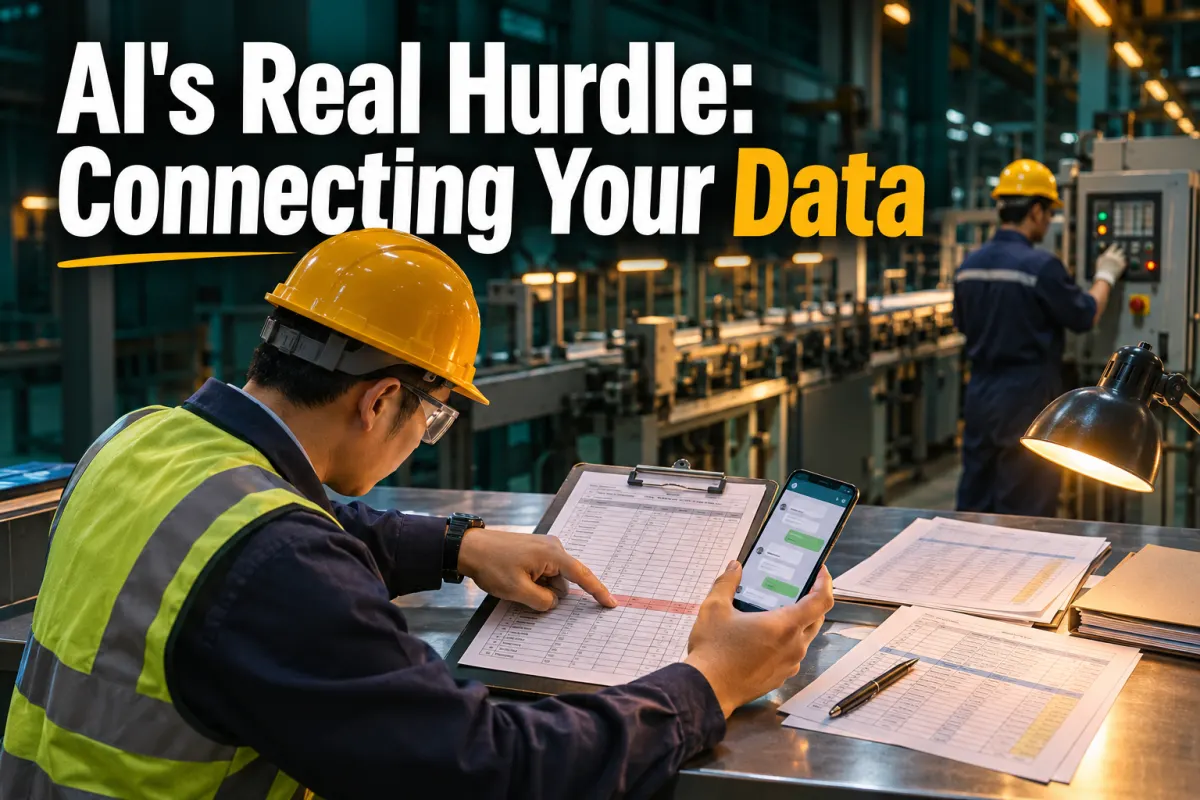
Microsoft's recent partnership with Lumen Technologies is a small piece of news, but for small and medium-sized enterprises working out how to put AI to use, it deserves a closer look.
According to a report by Hong Kong Economic Times, Microsoft and Lumen Technologies have agreed to cooperate in helping enterprises integrate cloud and network capabilities and accelerate AI scale-up. The report identifies a key bottleneck in enterprise AI adoption: the data, applications and infrastructure that AI workloads need are scattered across public clouds, private data centres, offices and partner environments, and connecting them is itself a challenge.
Our view is direct: the first threshold for enterprise AI is no longer whether the model is smart enough, but whether your own data can be securely connected to it.
Why "can't connect" is more fatal than "can't use"
Many bosses imagine AI as: buy an account, let employees ask a few questions, and efficiency will rise. That image holds up, barely, for writing copy or looking things up, but falls apart when applied to real business tasks.
Take manufacturing. Microsoft's own material on AI in manufacturing lists the uses clearly: predicting equipment failures, using computer vision for quality inspection, optimising supply chains and inventory, and adjusting energy consumption based on real-time data. None of these can be done by "asking a question"; all require that real-time data from the production line first be read and understood by the system.
The problem is that most SME data looks like this: orders in WeChat, inventory in Excel, equipment logs on industrial PCs, customer records on the boss's own phone. However powerful the AI, if it cannot see these, it can only give generic answers.

This is why Microsoft is bringing in a network vendor. If the connectivity layer does not work, the intelligence on top is a castle in the air. Even large enterprises need dedicated integration; SMEs that still expect "out-of-the-box" will most likely be disappointed.
The counterargument: small firms have less data, so it's less complex
There is half a truth to this. Companies with small data volumes and few systems do face lower integration difficulty. A restaurant owner with only two or three outlets can get AI to help simply by sorting out ordering and inventory.
But "less data" does not mean "clean data". Little but messy data is harder to handle than much but organised data.
So this judgment has a clear condition under which it does not hold: if your business data is already concentrated in one system, with standard fields and unified definitions, then integration is not the main problem, and what you should worry about is which scenario to start with. Conversely, as long as your key data is still scattered between people and spreadsheets, solving connectivity and definitions first is far more worthwhile than chasing the newest model.
What this means for teams going global
Teams going global feel this problem earlier and more acutely. Multiple currencies, multiple time zones, multiple platform backends: data is naturally dispersed. The signal from deals like Microsoft's is that competition in enterprise AI will shift from "whose model is stronger" to "who can connect and govern an enterprise's data reliably".

The trade-off for operators is also clear: when budgets are limited, do not rush to pile up tools. First work out which part of the business most deserves to be seen by AI. Is it procurement costs, inventory turnover, or compliance checks on application materials? Pick one segment, straighten out its data sources and definitions, and that is more practical than rolling out ten scenarios.
The cost of falling behind will not show up immediately, but it accumulates: peers use AI to save time on repetitive checks while you still flip through pages by hand; peers spot problems quickly from data while you wait for the month-end report.
One thing you can do now
Pick a task you repeat every month and are especially afraid of getting wrong. Gather all the raw materials it involves and see whether a machine can read them directly.
Along these lines, SHEYU AIZHISHEN is a concrete approach: it turns technology project application materials into a verifiable evidence table, reading tens to hundreds of pages in seconds, with every extracted value carrying a page number, the original text and dual-engine cross-checking, and every conclusion traceable to the original guideline text. Four-value results do not pass by default, and data does not leave the internal network.
What it cannot do should also be stated clearly: it does not decide for you whether to apply, nor does it guarantee that materials will pass review. It solves the "checking" segment. If your pain point is not checking application materials, it will not help.
What the Microsoft-Lumen deal really reminds SMEs of is this: most of the work of putting AI into practice lies in connecting data. There is no shortcut, but you can start with one segment of the business.