 SHEYU.AI
Most bids fail on missed requirements, not weak proposals
Most bid failures stem from missed hard requirements scattered across tender documents, not weak proposals; the article examines why "missing nothing" is harder than "writing well," how peers split bidding into extraction, drafting and veri
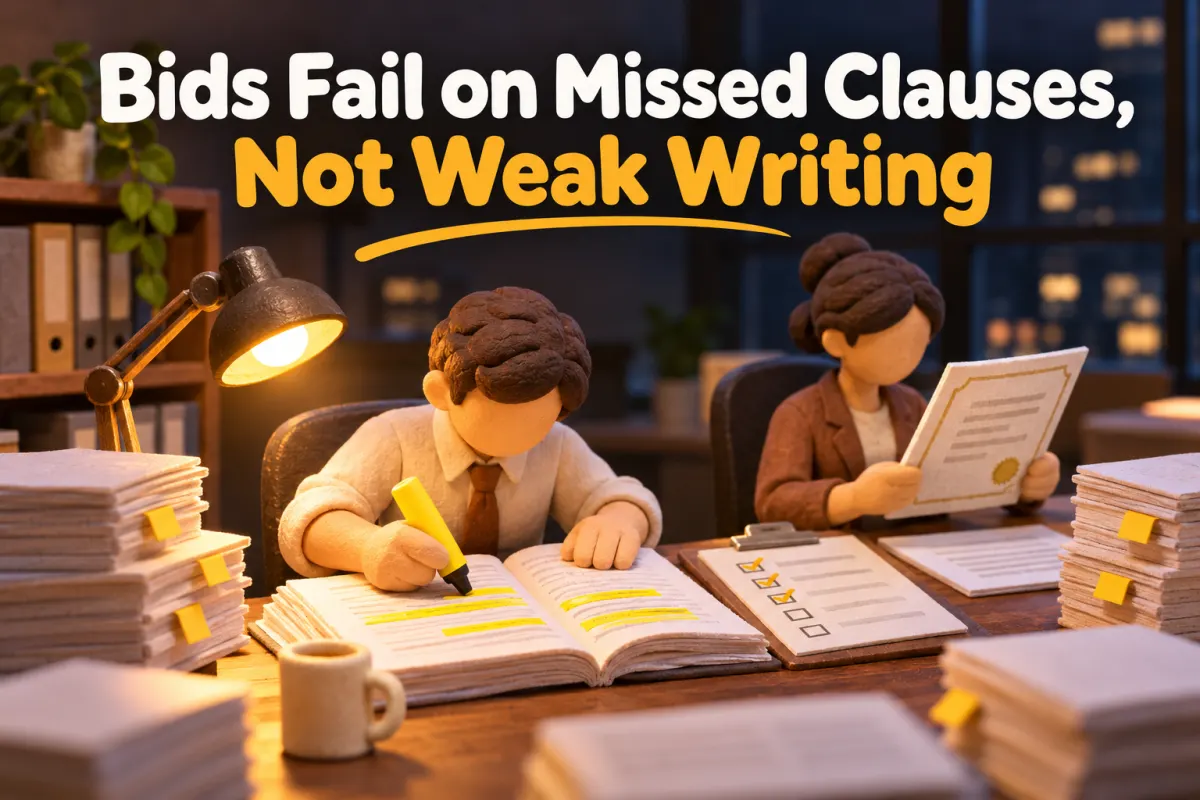
Most bid failures are not caused by proposals that are too thin. They happen because hard requirements scattered across hundreds of pages — qualification clauses, scoring rules, response items — get missed. A single disqualification costs not just the deal but weeks of team time and earlier investment.
The real threshold in bidding is not writing well. It is missing nothing.
Why "missing nothing" is harder than "writing well"
Tender documents routinely run dozens or hundreds of pages, with core elements scattered across project basics, document requirements, disqualification clauses, scoring standards and qualification lists. The difficulty is not that a person cannot read every page. It is that memory and focus cannot guarantee nothing is dropped across that many pages.
According to a test reported by Yunbaba in "How good is WorkBuddy at writing bids? A hands-on walkthrough of the full bid document process," a systems integration company ran a comparison: manual extraction of a tender document took four hours, while a platform produced the checklist in twenty minutes with no omissions. The gap is not intelligence. A machine does not start losing focus on the third day of overtime.
The bigger problem is that bidding is a low-tolerance activity. According to the Sohu timeline article, the larger the bid, the more complex the rules, and the easier it is for human effort to slip on details. Miss one registered-capital clause, or find that a similar-performance certificate does not match the required years, and all prior investment goes to zero.

What peers are doing
According to the Yunbaba walkthrough, a practical industry approach splits bidding into three layers: extraction, drafting and verification. The extraction layer structures the tender document and outputs three lists — qualification thresholds, scoring methods with point distribution, and disqualification clauses. The drafting layer generates chapter frameworks and commercial response tables by scoring point. The verification layer intercepts three risk types before finalisation: format, consistency and completeness. Three decisions stay with people: pricing strategy, technical commitments and qualification compliance.
According to the Sohu timeline article, Yuanqi Zhibiao's approach is to upload the tender document, automatically extract project basics, document requirements, disqualification clauses, scoring standards and qualification lists, and generate a structured analysis report. Bid staff receive not hundreds of pages of source text but an organised checklist of bid points. It does not replace human judgment; it compresses "search the whole document for what matters" into seconds.
The Yunbaba article also notes a detail: one company reviewed twelve bids from the past three years, identified four high-frequency scoring-loss points and improved each one. Historical bids are not just archives; they can be analysed against each other. Which chapters recur in high-scoring bids, which phrasing converges across losing bids — the human brain cannot hold these patterns, but they can settle into a company's bidding experience base.
A common counterargument
Some say AI-generated bids are formulaic, need more revision than a human draft, and are not worth the trouble.

The point has merit, but it misreads where AI sits in the bidding process. According to the Sohu timeline article, AI's most valuable role is not "automatically generate a document" but first untangling the rules themselves. According to the Yunbaba walkthrough, the platform carries the main workload in extraction, drafting and verification, while pricing strategy, technical commitments and qualification compliance must stay with people. Use AI as a ghostwriter and you will indeed get a formulaic draft. Use it as a tool to unpack rules and block risk, and what you save is page-turning and cross-checking time.
When does this judgment not hold? If the tender document is only a dozen or so pages, the clauses are simple, and the team has bid on many projects of this type, manual page-by-page reading may cost less than configuring a tool. A tool's value rises with rule complexity; not every project justifies a system.
One thing SMEs can do now
Do not start by buying a full system. Take a tender document you bid on recently and manually list disqualification clauses, scoring methods and qualification requirements as three separate checklists. Then check whether everyone on your team received all three last time. According to the Yunbaba article, one company had a qualification clause known to only one person, and an omission occurred during handover; the risk was only removed once the structured checklist was shared with commercial, technical and finance teams.
Once that is done, you will know whether you lack the checklist habit or lack a tool that can produce the checklist in twenty minutes.
SHEYU LEIDA (舍予AI招标雷达) addresses a different segment: it aggregates national government procurement and tendering information, with real-time subscription pushes by keyword, region and industry, so bid notices are not missed. It solves "has the opportunity reached you," not "how to write the bid." Individual users can register directly via the iOS app or mini-program; the channel edition does not support self-registration and requires contacting sales. If your problem right now is scattered information sources and good projects that have already closed by the time you see them, start with subscription pushes.