 SHEYU.AI
Can an AI steward manage the books for market operators? Start by asking which bills are overdue
AI in commercial leasing is less about making decisions than surfacing the right numbers under clear data permissions, and that depends on books that reconcile.
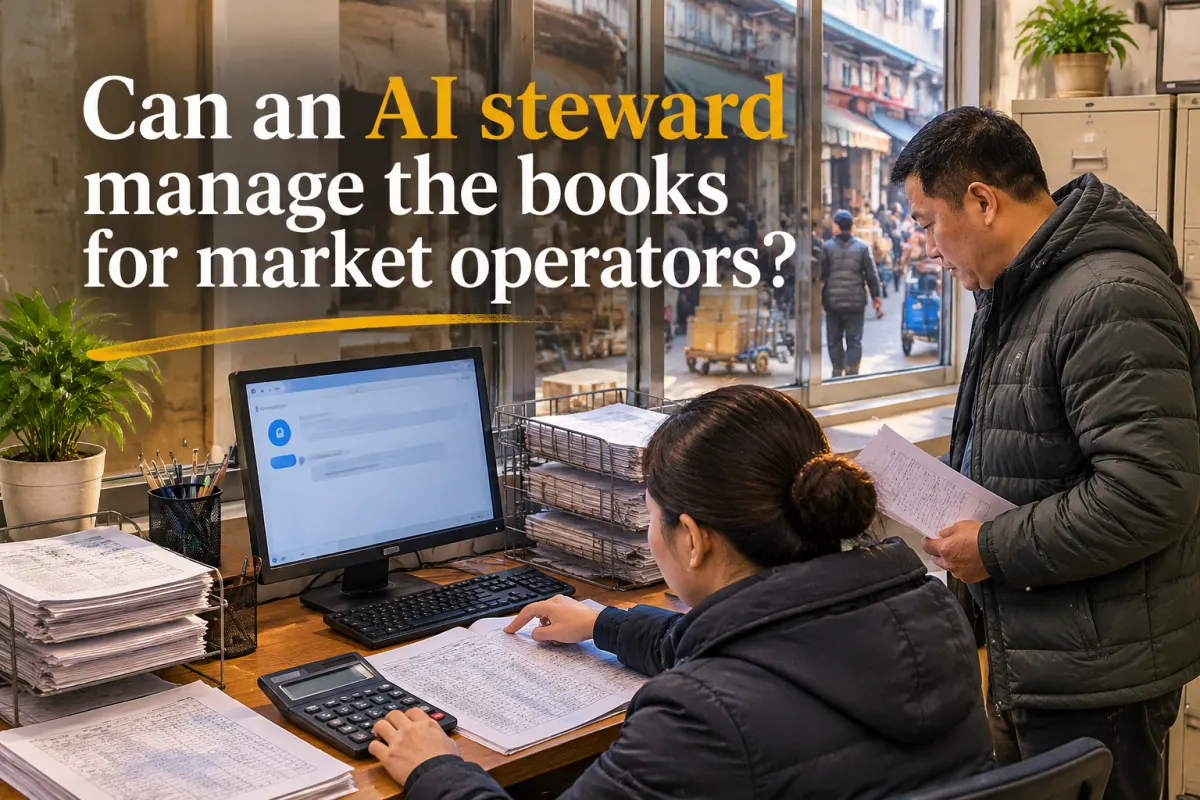
For operators of commercial leasing and mixed-use markets in China, AI entering the operating system is no longer a question of whether it can be used. It is a question of data permissions, lines of responsibility and whether the accounts add up. Our view: the real value of AI to a market operator is not making the call for you, but putting the numbers you should be looking at in front of you first.
Why AI in operating systems stalls first on who gets to see the data
Two details in a recent Singapore government reply are worth noting. One is AI Verify, positioned as a self-assessment tool to demonstrate that AI deployment is responsible. The other is a consultation guide under the PDPA on the use of personal data in AI systems. Both point the same way: before AI can be put to work, it must be clear how data is used, who can see it, and who is accountable when something goes wrong.
In commercial leasing the problem becomes more concrete. What sits in a market's operating data? Unit status, contract terms, bill amounts, merchant arrears, meter readings, lead follow-up records. Once this data is handed to an AI question-and-answer tool, the first question is not whether the AI is clever, but whether it will tell merchant B about merchant A's arrears.
In the SHEYU AI commercial leasing system, the AI steward is described on the official site as answering read-only, querying according to the logged-in user's permissions and not exceeding them. The weight lies in the two qualifiers: read-only and according to permissions. It does not change contracts for the operator, does not automatically waive bills, and does not bypass the logged-in user to see data that user has no right to see. This maps onto the governance logic above: AI first handles the numbers that can be seen, not the decisions that are yours to make.
What market operators actually ask the AI
Shu Yi, executive director of SHEYU JIYE, puts it this way: AI will not make decisions for the operator; it puts the numbers the operator should see in front of them first.
In daily practice, that means a few unglamorous but everyday questions: which bills are overdue? Which leads should be followed up? Which unit has been vacant longest?
The traditional approach is to leaf through ledgers, call the leasing team, and wait for finance to issue month-end reports. Shu Yi has a more direct line: the thing leasing follow-up fears most is not a lack of leads, but leads sitting there with nobody chasing them.
The AI steward's capability boundary here is clear: it answers what the situation is now, not what you should do. Which bills are overdue, it looks up for you; whether to give this merchant a few more days' grace is still the operator's call. That boundary is not exciting, but for frontline use it is enough — the operator does not need to learn the system, only to ask in plain language.
If the books do not reconcile, a faster AI answer is useless
Here is a counterintuitive judgment: however smoothly the AI question-and-answer works, if the contracts, bills and meter readings underneath do not run on a set of accounts that reconcile, the numbers it returns will be wrong.
The SHEYU AI commercial leasing system runs contracts, bills, commissions and meter readings on a database transaction engine — in the official site's words, effective on activation and settled on lease exit, with numbers that reconcile and cannot be altered into disorder. Overdue routing, billing by payment period and payment reconciliation are handled by scheduled tasks that run automatically every day. These mechanisms are not AI capabilities; they are the precondition for AI being trustworthy.
In other words, the AI steward is the mouth at the front desk, and the transaction engine is the ledger in the back office. However fluent the front desk, if the back office turns every edit into disorder, the operator will sooner or later not dare to use it.
Who can seize this opportunity first, and where the threshold lies
The Singapore reply dates from 2023. It is not a new policy of today, nor does it constitute a subsidy or compliance commitment for Chinese enterprises. It offers a mirror: as AI enters operating systems, both regulators and the industry are moving towards the verifiable, the accountable and the clearly permissioned.
For operators of mixed-use markets and commercial complexes, those who can seize this opportunity first are not the ones who buy the most expensive system, but the ones who first identify the thing that repeats every day and goes wrong every day. Shu Yi's formulation: in digitalisation, first find the thing that repeats every day and goes wrong every day, and start there.
The threshold is practical. First, your contracts and bills must be digitised first; paper ledgers cannot be fed into AI. Second, the permission structure must be sorted out first — who should see the data for which units. Third, do not expect AI to make business judgments for you; it is only responsible for laying out the numbers clearly.
Who the SHEYU AI commercial leasing system suits, and who it does not
It suits operators of mixed-use markets and commercial complexes — those with units, contracts, bills, meter readings and leasing leads to follow up. Asset and lease control, leasing CRM, the contract and billing engine, property and IoT, internal office, and food-ingredient distribution supply chain: these modules are built around the positioning of one system covering the whole of a market's operations.
Who does it not suit? Not a single store that only wants a cashier tool, and not anyone expecting AI to negotiate with merchants on their behalf. The AI steward answers read-only; decisions on leasing negotiation, bill waivers and contract terms remain with people. On how to judge whether software is well chosen, Shu Yi's view: do not look at how long the feature list is, but at whether it lets frontline staff do one step less.
AI entering operating systems will not, in the short term, have any policy to fall back on. The real dividing line is whether your books can be asked clear questions.