 SHEYU.AI
Singapore SMEs pay twice for shallow AI use, and the bill needs recalculating
A Singapore minister cites regional data showing broad AI adoption but shallow intensity, and the gap lands hardest on SMEs that have not written down their processes.
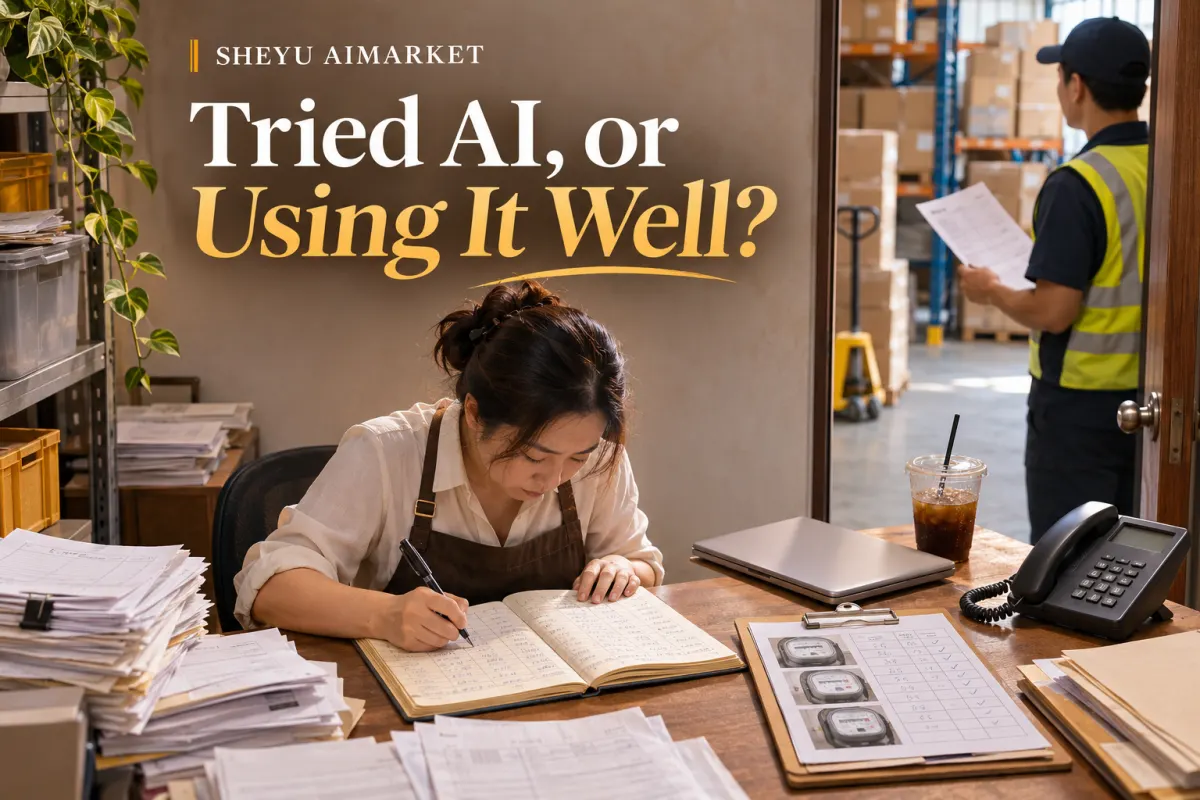
According to a transcript of a ministerial speech published on the website of Singapore's Ministry of Digital Development and Information (MDDI), Jasmin Lau, Acting Minister for Manpower and Senior Minister of State for Digital Development and Information, presented a pair of contrasting figures at the 41st ISEAS ASEAN Roundtable. A Southeast Asia digital economy report by Google, Temasek and Bain estimates that 243 million people across the region's six largest economies already use generative AI, equivalent to 58% of the labour force. On the same per-capita basis, however, Southeast Asians use AI at roughly one-tenth the intensity of Americans.
Her conclusion was blunt: most people have stopped at "having tried AI", and the next stage is about "using it well".
For Singapore's SMEs, the arithmetic needs redoing. Shallow AI use is not a saving; it means paying the labour cost twice.
58% have tried it, one-tenth the intensity in use: where is the gap
Separate the two numbers. The 58% measures reach; the one-tenth measures intensity. Reach shows that the "can I get access" threshold has largely been crossed. Intensity shows that the "have I wired it into daily operations" threshold has not.
In the same speech, Jasmin Lau flagged her concern: large enterprises are better placed to scale AI, and SMEs may fall behind.
That is not a courtesy line. Scaling presupposes that a process can be broken into explicit actions — who follows up a lead, when an invoice goes out, how meter readings enter the books, how a lease exit is settled. Clear processes give AI something to do; vague processes leave AI with nothing but conversation.
The typical SME state is the latter: few people, tangled tasks, and the boss is the process. The AI gets bought, used for two days, and set aside.
The counter-argument: small firms are simple, so they don't need AI
This is the objection we hear most often, and the one that most comfortably justifies doing nothing.
It is half right. If the business really is simple, volumes really are small, and one person with a pen can remember everything, then no system is needed, let alone AI. Spending money on tools in that situation is inventing work for yourself.
But the conditions under which it fails are equally clear. As soon as any of the following appears — leads scattered across several people's WeChat with nobody following up, invoices tracked by hand and chased through personal favours, meter readings patched together at month-end, contracts expiring with no advance warning — the business is no longer simple. It has simply never been written down.
A process that is not written down does not become simpler because the company is small. It becomes invisible overtime in the owner's head.
The barrier is not technology but whether the process has been written down
Think this through and the location of the opportunity window becomes clear.
What AI can genuinely take off people's hands in an operating context is the repetitive action with a clear input, a clear judgement and a clear result. Examples: follow-up reminders on investment leads, chasing overdue invoices, generating bills after meter readings. Their defining feature is that skipping them causes leakage, doing them brings no sense of achievement, and small teams postpone them to the last minute.
Jasmin Lau's "from tried to using well" lands, for an SME, at exactly this step: move these actions out of people's heads and into something that runs in a system, and AI has somewhere to take over.
Conversely, if a company's accounts, contracts and unit status still sit in Excel and paper ledgers, no AI can pick them up — there is no readable source document.
What this kind of system can and cannot do
Take commercial leasing and integrated markets as an example. SHEYU's commercial leasing system (SHEYU AIMARKET) puts asset and lease control, investment CRM, contract-to-invoice generation, dunning and online payment, and meter-reading billing into a single middle platform, with an AI steward handling actions such as investment follow-up, invoice chasing and meter-reading billing. According to its website, operations that write to the database go through two steps, "preview" then "confirm", and leave an audit trail after execution; fund-related actions such as meter-reading billing, contract activation and lease-exit deposit refunds are executed uniformly by a transaction engine.
The boundary should be stated plainly: it connects to leasing operations that are already structured. If a company's core business is not built on the logic of units, contracts and invoices, it will not help; and if the process itself has not been straightened out, installing a system only moves the chaos onto a computer.
One thing to do now
There is no rush to pick a tool. First spend half an hour listing the operating actions you personally performed this week that recur three times or more — follow-up, chasing payment, reconciliation, expiry reminders, any of them.
Once the list is done, you will find that the line between what can be handed to a system and what only you can carry is clearer than you imagined. The opportunity window for AI is nowhere else; it is on that list.
Sourced from the transcript of Jasmin Lau's speech at the 41st ISEAS ASEAN Roundtable on the MDDI website; the Southeast Asia digital economy figures are cited from the Google, Temasek and Bain report referenced in that speech.