 SHEYU.AI
How high-end hotels can make their service legible to AI
As travellers increasingly state needs rather than search, hotels must turn tacit service knowledge into content AI can read, call and recommend.
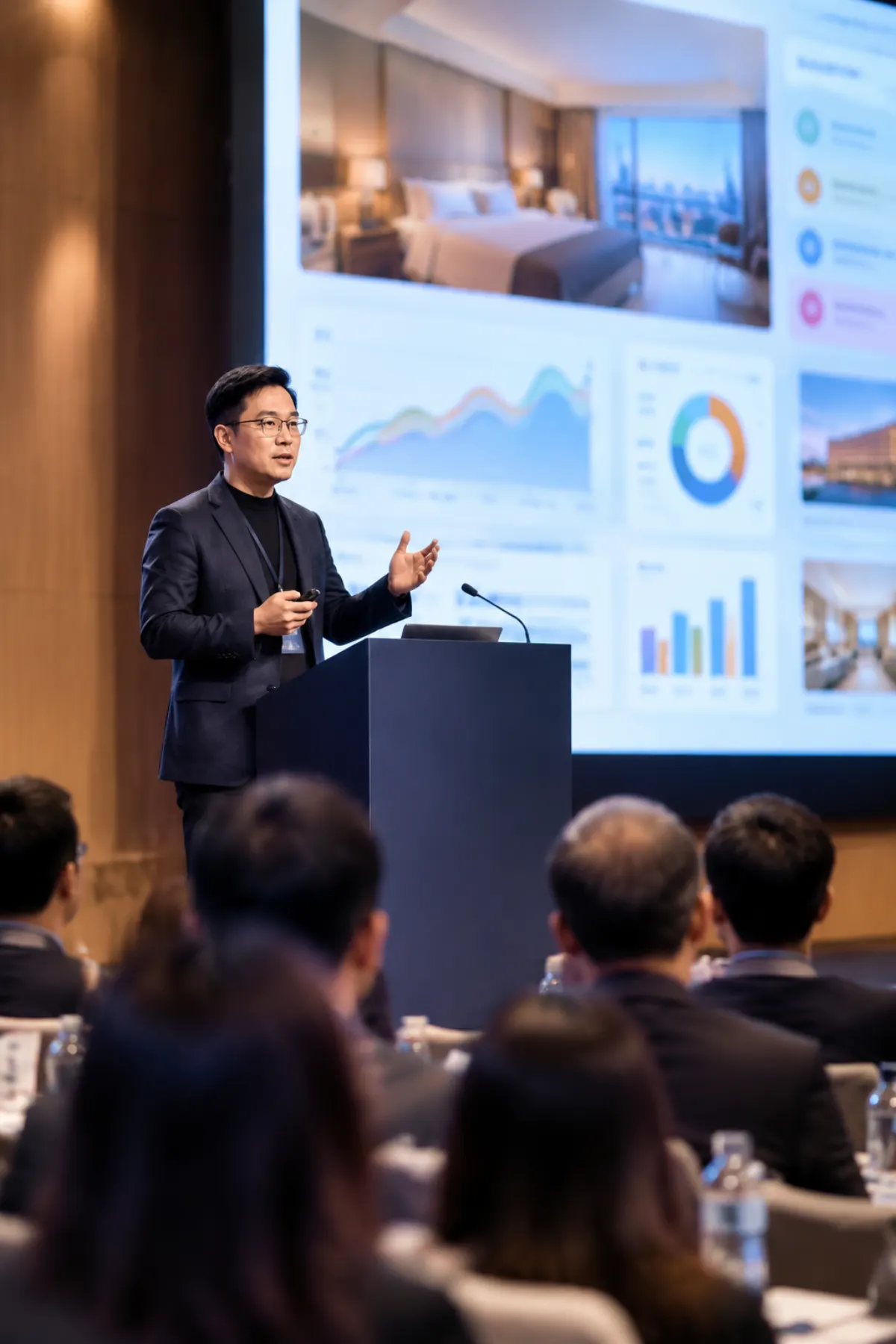
How high-end hotels can make their service legible to AI
"Users are moving from searching for hotels to simply stating what they need."
At the 2026 Global Travel Media Summit, Fliggy CTO Chen Ye put that shift directly to hoteliers.
For a high-end hotel with several hundred rooms, it means something concrete: the service you are proud of, if it lives only in employees' heads, is invisible to AI and cannot be invoked by it.
The change starts with how guests find you
Chen Ye's argument is that OTAs once changed how people book hotels, while AI is now changing how people find them.
A user might say only: "Find me a hotel in Beijing, staying five days with my parents, not too far from the sights, moderate budget, preferably quiet." The destination, dates, budget and itinerary are then broken down by AI.
The question for hotels changes accordingly: why should AI recommend you to the user?
By the criteria he gave at the summit, AI's basis includes whether real-time inventory is accurate, whether pricing is flexible, whether product information is complete, whether cancellation rules are clear, and whether service capability can be identified and invoked. Most hotels already hold the first few items in their PMS.
The last one is where many high-end hotels come up short — service is caught on the spot by staff, and never settles into something that can be read.
Three things that can be done now
One: turn the questions guests keep asking into standard answers
The method is unglamorous: have the front desk and customer service spend a week logging every repeated question — what time breakfast starts, whether an extra bed is possible, how late checkout is charged, whether parking is free, how invoices are issued, whether airport transfers exist. Twenty or thirty questions usually cover 80% of repeat enquiries.
Compare that with Chen Ye's "whether service capability can be identified and invoked".
This capability is not built by adding staff. It depends on having one consistent line: a guest asking at any entry point gets the same answer. High-end hotels already have that line — scattered across training manuals and veteran employees' memory. What is missing is fixing it into individual pieces of content that can be invoked, rather than improvising each time.
Two: compress the steps before a pricing decision to under a minute
The revenue manager at Hangzhou Radisson adjusts prices three to five times a day, and more than a dozen times during Golden Week.
What slows him down is never the judgement but the data retrieval. According to Cover News reporter Zhang Yuexi, this hotel used to take five to ten minutes to look up a single operating figure; after adopting Meituan's Jibai flagship edition, released on September 23, it takes about one minute.
Among the same group of co-built hotels, Chengdu Shangjinpin compressed its monthly business analysis from most of a day into a single instruction, with diagnostic accuracy reported at 98%.
The point is not to let AI price for you, but to solve the small matter of retrieving data within a minute first, so people have their hands free to judge.
Three: loosen the repetitive actions at the front desk first

The public case for Lyuzhiyun PMS: after nearly 300 Mehood Hotel stores came onboard, front-desk room assignment efficiency rose 90%, overall operating efficiency rose 30%, and labour costs fell 30%.
The three figures say the same thing — room assignment, check-in and message-passing should not be occupying the front desk's attention in the first place.
Recalculating scale and customer acquisition
The China Hotel Association's 2026 China Hotel Industry Development Report shows that by the end of 2025 China had 374,700 hotel establishments and about 18.7364m rooms, with a chain rate of 41.8%. Nearly 60% of non-chain independent hotels face customer loss and profitability pressure.
Ma Yingyao, founder of Shangmei Shuzhi, told Times Finance something weighty: past gains from opening stores and cutting costs by removing the front desk are showing diminishing marginal returns, and "there is only one standard for winning — whether you can become the user's first choice in a given track".
He points to 4,300 hotels across 1,884 districts and counties and 137m members, and still concludes that the front desk has again become a key point of contact with users.
As acquisition costs rise, the link that reaches guests directly becomes valuable. AI is entering from both sides at once: on the guest side it completes the choosing; on the hotel side it begins to catch part of the contact.
How to put this into practice
Of the three items above, the first is the most underestimated.
It does not require replacing systems first, but it does require something that can catch guest questions while keeping one consistent line — which is the part SHEYU AIHOTEL handles.