 SHEYU.AI
Southeast Asia's AI gap is about depth of use, not access
Southeast Asia has 243 million generative-AI users but per-capita use is about a tenth of America's. For small firms, the gap is depth of use, not access.
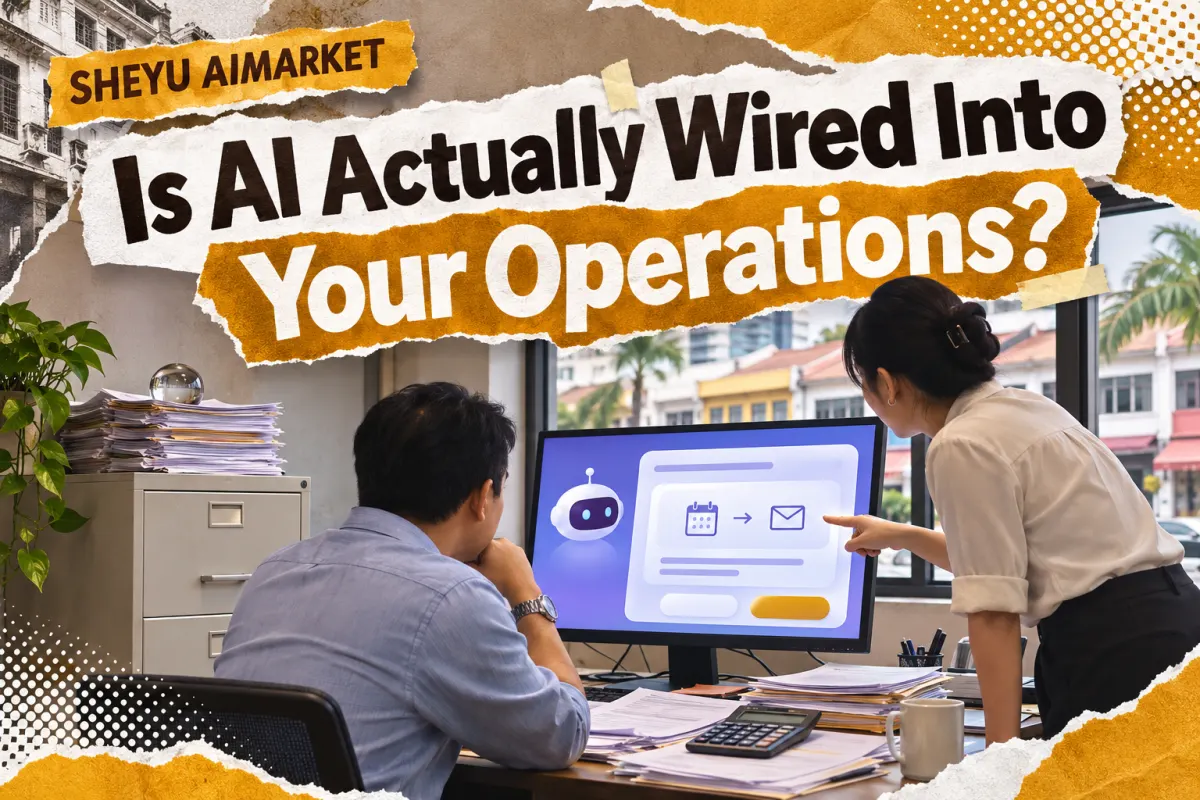
Southeast Asia has 243 million people using generative AI, yet per-capita usage is roughly a tenth of America's. The gap that matters for smaller companies is not access to models but whether AI is wired into the operating actions that generate revenue and cost.
What the numbers actually say
According to remarks by Jasmin Lau, Acting Minister for Manpower and Senior Minister of State at Singapore's Ministry of Digital Development and Information (MDDI), at the 41st ISEAS ASEAN Roundtable 2026, published on the MDDI website, 243 million people across Southeast Asia's six largest economies already use generative AI — equivalent to 58% of the labour force.
The same remarks contain a sharper figure: on a per-capita basis, Southeast Asians use AI at roughly a tenth of the American rate. Lau's point was that many people have tried AI, but moving from "tried it" to "using it well" is the task of the next phase.
That distinction is worth dwelling on. It describes not a technology gap but a gap in depth of use.
Why many have tried and few use it well
For most people, "using AI" still means asking a question in a chat box and getting an answer. That is not management.
The real gap appears at the organisational level. In the same speech, Lau flagged her concern that large enterprises are better placed to scale AI, while small and medium-sized enterprises may fall behind. This is not alarmism. Large companies can connect AI to contracts, bills and work orders — processes that run every day. If a small company's owner merely asks a phone a couple of questions, it stays permanently at "tried it".
In other words, the barrier is not whether you know how to use AI, but whether it is connected to the few actions that actually produce money and cost.
Where smaller firms get stuck
They get stuck at the point where "the system does not recognise what AI says, and AI cannot do the work inside the system".
A typical scene: a leasing lead is followed halfway and then forgotten; a bill falls due with no one to chase it; meter readings have to be copied by hand. These tasks are not difficult, but they are fragmented, repetitive and easy to miss. When people get busy, they postpone them — and the result is vacancy periods and bad debt. This is exactly the work AI should take on. But if AI only tells you in a chat box that "it's time to chase the payment", and you still have to go into the system and click through it yourself, then nothing has been connected.
What "connected" looks like
It means AI can read the real data in your system and actually execute actions there — with a brake at every step.
Take SHEYU's commercial leasing system, SHEYU AIMARKET. It occupies this position: leasing leads followed up automatically, overdue bills chased, meter readings billed, contract activation and lease termination handled by an AI steward. More important is its write-operation mechanism — four gates in front: permission checks, tenant isolation, preview (without writing to the database), and confirmed execution with an audit trail. The AI first shows you what it intends to do; only when you confirm does it actually write to the database.
This deserves to be stated clearly: it is not "AI makes decisions for you", but "AI takes the work to the final step, and you take that step". For asset owners such as commercial complexes and general markets, this calibration is more useful than full automation — when it comes to money, no one dares let go entirely.
The boundaries should also be stated: this system covers the leasing operation segment — asset leasing control, leasing leads, contracts and bills, property and IoT, and internal office work. It is not omnipotent. How well it connects to your other business systems, and how clean your own data is, will both affect how well it works. Expecting it to save money automatically once installed is unrealistic.
How to think about timing
There is no deadline, but there is a very practical order of operations.
Pick one link that leaks money every day — bill chasing, say, or meter reading and billing — connect AI to it and run it for a while, to see whether it genuinely reduces manual work. Once that runs, expand to lead follow-up and contract affairs. Conversely, aiming for full-process AI from the start will most likely stall at the data-cleaning step.
What needs to be caught up is not the tool but the density of use.
Southeast Asia's per-capita AI usage is a tenth of America's. That gap cannot be closed by buying a few more accounts; it is accumulated by pressing AI into daily operating actions, one at a time.
Large enterprises are already doing this. For smaller firms starting now, what they are chasing is not technology but time.