 SHEYU.AI
China's business associations are busy hosting events, but the follow-up is where they lose members
Two packed September events in Shanghai and Qingdao show Chinese trade associations excel at drawing crowds but struggle to turn attendance into a usable member list.
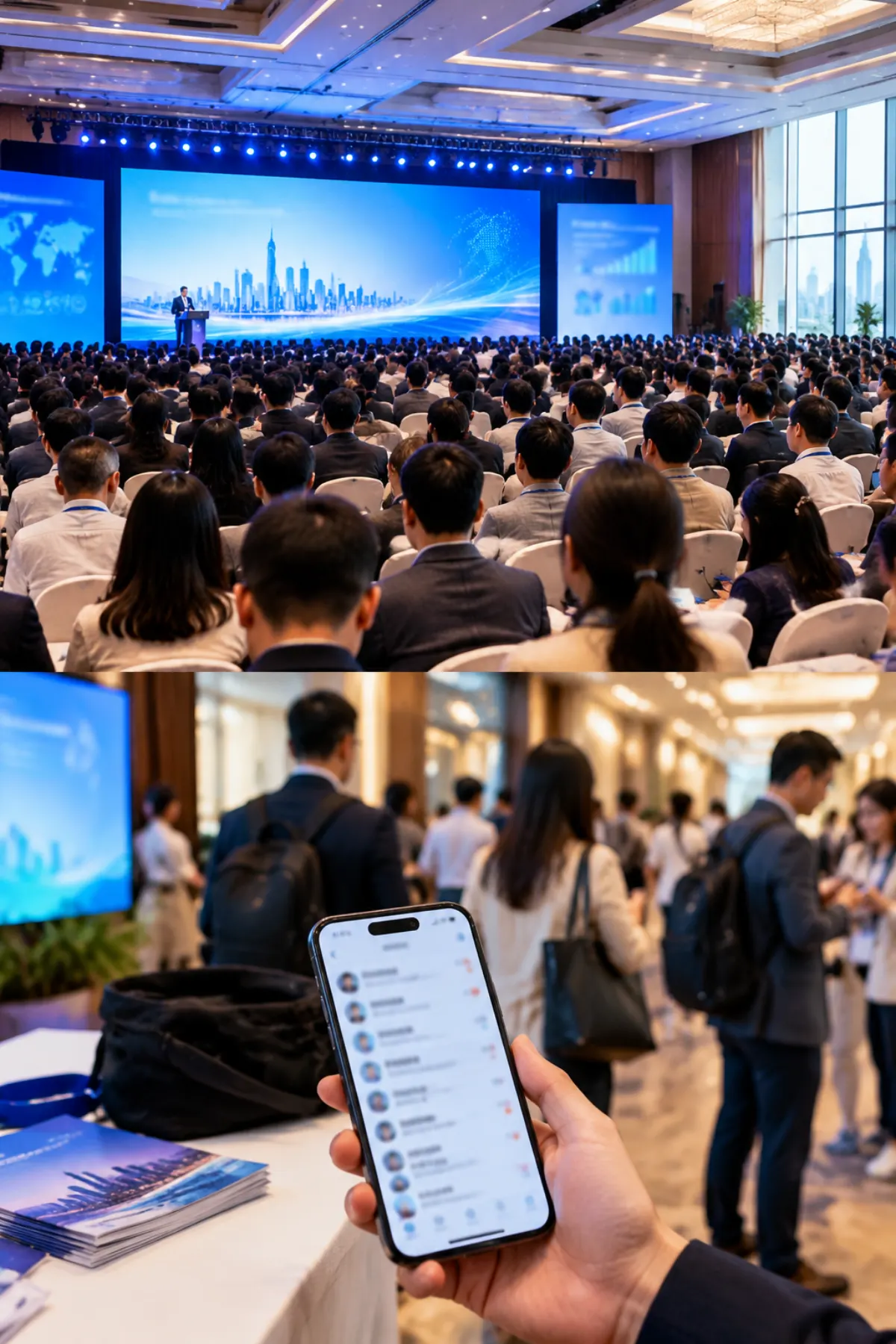
Two September gatherings — one in Shanghai, one in Qingdao — drew hundreds of representatives each. Both were well attended. What determines whether they were worth the effort is what happened in the three days after the doors closed.
More events, thinner follow-up
China's business associations have expanded quickly in recent years.
Figures from the Federation of Industry and Commerce in Dongxihu District, Wuhan, illustrate the trend: the number of local associations rose from 12 five years ago to 33 — 12 street-level chambers, 11 industry chambers and 10 regional chambers, with more than 3,500 member companies between them. The food and health chamber alone held 12 events in a single year, generating more than 100 intended partnerships worth nearly Rmb30m.
Service volume has risen. The stock of usable service assets has not.
Registration runs through group chat relays; sign-in runs on a sheet of A4 paper. A guest's presentation is posted to a WeChat group and buried within three days. Companies that said they wanted to connect are remembered only by the secretary-general. A 500-person go-global matchmaking event often ends with nothing but a group photograph.
The broken link is not acquisition — it is what comes after
Many assume the hard part for associations is getting people in the room.
The opposite is true.
Themes such as going global, AI and digital trade do not lack for attendees. What is missing is the ability to turn those attendees into a list that can be reached again and again.
The Shanghai event brought together representatives from government bodies, industry associations, AI companies, cross-border service providers and overseas Chinese chambers. The Qingdao session was aimed squarely at the machinery industry belt. Both were high-quality acquisition settings. But without a directory, a record of needs and a channel for a second approach, 500 people remain just 500 people.
The practical constraint is real: secretariats typically run on two or three staff.
The Tianjin SME Economic Development Association is building an expert database to offer members guidance on management and transformation. The direction is sound, but execution still falls to the same few hands.
"A WeChat group and personal ties are enough"
This is the most common objection we hear: chambers run on shared hometown ties and trust, not systems; group chat relays are convenient, so why bother.
Personal ties do work. But they depend on frequency of contact, and frequency has a ceiling. One person can genuinely remember and follow up with only so many companies — a few dozen at most. When membership runs to 3,500 companies, and a single event draws 500, relying on memory turns the rest into members in name only.

A WeChat group is not a directory either. It allows conversation, but it cannot filter people by industry, show who attended which event, or pass a business card along cleanly.
The real relationship asset is information that can be searched and reused — not a group sitting on hundreds of unread messages.
A digital salon held in Beijing's Xicheng district on September 22 focused on lightweight paths to AI adoption for small and medium-sized enterprises.
That phrase is apt. For associations, there is no need for a heavy system rollout; starting with registration and sign-in at the next event is enough.
How to put it into practice
This kind of problem can be handed to SHEYU AISO. It integrates chamber WeChat mini-programs, association cloud platforms and alumni systems into a single package that associations can use as-is. Registration and sign-in settle directly into a list; member directories and electronic business cards let secretariats find the right people by industry or need at any time; news, live streaming and video accounts let members who did not attend stay connected.
It cannot build personal ties for a chamber, but it can keep those ties from being lost.
The real asset of an association is never how many events it held in a year, but how many people it can still name and reach once the event is over.
Changing this can start with the next event — and it is not too late.