 SHEYU.AI
Singapore's S$154.7bn Budget Puts AI at the Centre — and Turns Subsidies Into a Paperwork Race
Singapore's 2026 budget rises to S$154.7bn with AI at its core. For Chinese firms going global, the money is there — but only for those whose local operating facts and paperwork hold up.
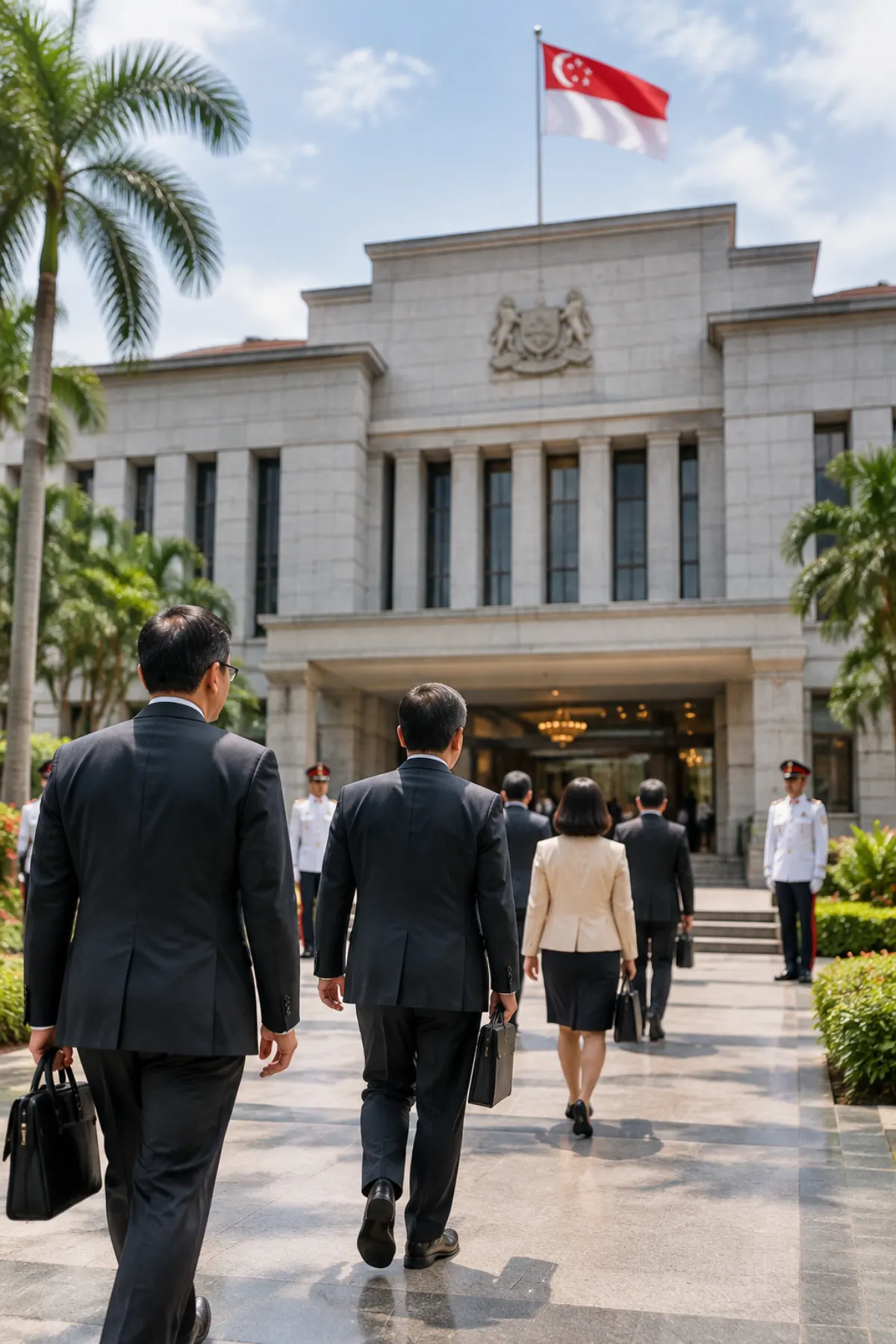
Singapore's 2026 budget puts AI at its centre. For companies going global, that cuts two ways: there is more money, but claiming it increasingly resembles a competition over documentation. Those who read the window correctly can push their digitalisation costs down this year; those who do not often learn the window existed only after it has closed.
First, see where the money comes from before reaching for it
The 2026 budget was tabled in parliament on 12 February, totalling S$154.7bn. In 2025 the figure was S$123.8bn — growth of roughly 25% in a year, and a record scale. The direction of the increase is clear, in three parts: workforce skills transformation, enterprise digitalisation subsidies, and investment in AI infrastructure.
For companies hoping to apply, the approach is plain — first set out your "Singapore identity" clearly: whether you are a local subsidiary, a branch, or an operating entity with local employees and a tax record.
Take an example. A Chinese team in cross-border e-commerce with only a receiving account in Singapore, no local employees and no tax record will fail the first filter for most digitalisation subsidies. Subsidies are not scattered by industry; they are given against verifiable operating facts.
The United States offers a contrast. According to a chronology of China-US trade disputes compiled by the Center for International Finance and Economics, on 29 July 2026 the US Commerce Department's chips research and development office signed letters of intent with seven companies to provide up to US$874m in federal R&D incentive funding under the CHIPS and Science Act, on condition that the Commerce Department takes a minority, non-controlling equity stake in each. Subsidies are not always free; this kind of consideration is worth thinking through in advance.
Public procurement doors are closing — do not treat Europe as the easy next stop
If EU public procurement is part of your business, it is time to calculate your "local content".
On 9 September 2026, the European Commission proposed new public procurement legislation explicitly introducing "made in Europe" standards and folding supply-chain resilience and economic security more systematically into procurement decisions. The European Innovation Act proposal tabled the same day introduces preferential arrangements for "made in the EU" solutions in public-sector R&D procurement. On 10 September, the Commission opened a public consultation for the first comprehensive review of the International Procurement Instrument (IPI) since it took effect — the instrument's first real use stemmed from the EU's investigation into China's public procurement market for medical devices, and imposed restrictions on relevant Chinese suppliers' access to the EU public procurement market.
The direction is clear: public procurement is shifting from "whoever is cheapest wins" to "whoever looks more local wins". This is not a rule that can be reversed in a year. The later you adjust, the greater the sunk cost.
Windows roll, but each one is short
On the Ai Nanshan enterprise services platform in Nanshan, Shenzhen, the application period for the 2026 professional leading incubation carrier support programme is stated precisely: it opens at 18:00 on 13 September and closes at 03:00 on 28 September. Less than a fortnight. This is the norm for such application windows.
So build yourself a window calendar, break your location, industry and subsidy type into keywords, and check once a week on a fixed schedule rather than waiting for a friend to forward something.

Another date falls in November. From 23 to 25 September 2026, Xi Jinping made a state visit to the United States; the two sides agreed to establish a China-US dialogue on artificial intelligence, to exchange views on AI-related risks and benefits, and to set up a communication channel for AI incidents, with the next dialogue scheduled for November 2026. They also reached a "US$30bn" reciprocal tariff reduction arrangement and advanced mechanisms including a trade council. Dialogue between China and the US on AI rules is back on a fixed track. Questions that were previously hard to answer — cross-border data, model compliance — will become clearer, but will also require you to produce evidence.
How to put this into practice
The real dividing line is documentation.
Whether for a subsidy application or a public procurement bid, the guidelines run from dozens to hundreds of pages, and every condition has to match. Miss one page reference and the review can send you back. In our view, the opportunity in this round is not in models but in paperwork.
This step can be handled with SHEYU AIZHISHEN. What it does is tightly focused: it turns science and technology project application materials into a checkable evidence table, reading dozens to hundreds of pages in seconds, with every extracted value carrying a page number and original text, cross-checked by a dual engine, and every conclusion traceable back to the original guideline text; four-value results are not passed by default, and data does not leave the internal network. For teams watching several application windows at once, what it saves is not typing time but review time.
What to do this year is not to wait for subsidies, but to get your operating facts and materials into a state where they can be submitted at any time. When a window opens is not up to you; whether you can submit when it does is.