 SHEYU.AI
A 3,000-yuan delivery order earns less than a 1,000-yuan dine-in one
Delivery commissions and subsidies are eroding tea-chain margins, pushing brands to bring dine-in customers back onto their own membership lists.
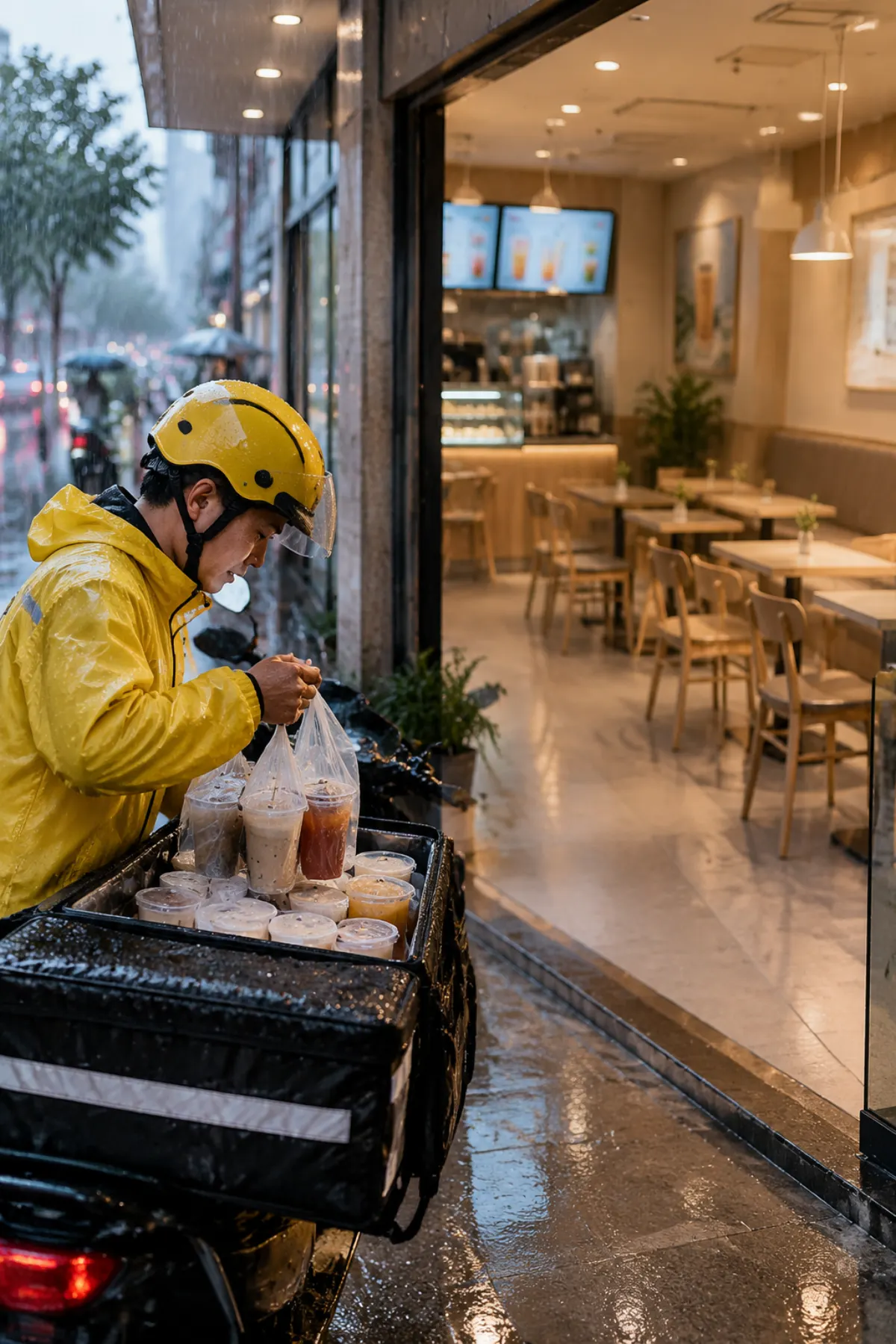
A 3,000-yuan delivery order earns less than a 1,000-yuan dine-in order. That line, from Guming founder Wang Yun'an at the company's March earnings briefing, captures the arithmetic now reshaping China's tea and coffee chains.
For the first half of 2026, average monthly dine-in GMV per store at leading tea brands fell 20.8% year on year. The test for a store has changed. It is no longer how many orders it can pull, but how much profit and how many customers it can keep for itself.
The same order, two sets of books
Wang was describing the profit gap on a single order across two channels. Delivery fees, platform commissions and continuous subsidies all take their cut. Across the industry, this is not one brand's complaint.
A report on China's restaurant digitalisation, jointly published by Tencent Smart Retail and Harvard Business Review, offers two figures. In 2025, transaction volumes across all restaurant channels rose 8.3% year on year, but the average spend per transaction fell from 37.07 yuan in 2024 to 35.34 yuan, a drop of 4.7%. That year, roughly 7.47m restaurant businesses were operating nationwide, while 3.39m closed. The average lifespan of a store shortened from 25 months in 2015 to 15 months in 2025.
Volumes are rising, prices are falling, and stores are dying younger. Together these three trends do not mean demand has vanished. They mean demand has become cheaper, and customers increasingly belong to no single store.
Tea and coffee feel it first
The same report shows that in the first half of 2026, average monthly dine-in GMV per store at leading tea brands was 30,780 yuan, down 20.8% year on year. For leading coffee brands, dine-in GMV per store fell 20.3%. Over the same period, 112 chain tea brands opened about 18,000 stores and closed about 11,000; 62% of them were shrinking or stagnant. Twenty-five chain coffee brands opened about 12,400 stores and closed 4,536, with the open-to-close ratio falling from 5.32 in 2025 to 2.73.
Delivery brings orders to the door, but it also changes who the customer is. What a store receives is a shipping note, not a name on a list. When subsidies stop, customers follow the platform. Whether the store's service is good or its product consistent matters little.
Foot traffic has not disappeared, it has moved
The report contains a counterintuitive set of numbers. In 2026, foot traffic in residential communities grew 4% in urban districts and 24% in suburban counties. Office-district traffic fell across every city tier: 5.0% in first-tier cities, 7.8% in new first-tier, 7.1% in second-tier, 3.8% in third-tier and 2.4% in fourth-tier and below.
Site selection used to answer one question: where are the crowds? Now it must also answer who these people are, why they are there, and how many other stores are competing for them.
Some brands are already moving in this direction. The report cites a leading coffee brand's smart site-selection system, which integrates its own data with mapping and delivery data from third parties into a visual "smart map" showing footfall, customer profiles, spending behaviour and store locations. More than 70% of the brand's new stores are now recommended by algorithm. That is the front end.

The back end is more grounded. A 36Kr report on restaurant founders tightening spending describes a freshly cooked fast-food outlet called Huogaogao. Located in a CBD commercial district, it devotes almost all its space to an open kitchen, uses disposable tableware, rotates just 10 dishes, and serves both breakfast and dinner. It explicitly does not do delivery. Group meal orders from nearby offices are taken through WeChat group sign-ups and delivered collectively. The same report mentions a staffing approach raised by an industry practitioner: work backwards from 100 yuan of revenue per person per hour, scheduling more hourly workers when busy and fewer when quiet.
The two approaches look different but share a core: hold foot traffic where you can call it by name. One uses algorithms to judge where people are; the other uses WeChat groups to gather them. Neither expects the platform to remember customers on its behalf.
Not every store can afford an algorithm team. What smaller outlets can do first is turn the most valuable dine-in customers from "scan, pay, leave" into people who stay in the pool.
SHEYU AIPOS addresses this specific point. A single POS system covers nine formats including tea, full-service dining, hotpot, delivery and retail. Scan-to-order lets dine-in customers settle naturally into the membership mall. During peak hours, payments still go through even when the network drops, so the busiest hour does not become the weakest link. The AI store manager lets an owner issue coupons, adjust prices and restock with a single natural-language instruction, sending coupons to their own members rather than waiting for the platform to allocate traffic.
It does not address the "bring in another batch of new customers" stage. It addresses the most critical stage in this article: whether you can name your dine-in customers, and whether they can find you again next time.
Channel pricing, shifting foot traffic and platform rules are beyond a store's control. What is within its control is a smaller matter: when that customer next stands at your door, does his phone hold your coupon, and does your back office hold his name?