 SHEYU.AI
Hong Kong family offices face mounting KYC record-keeping pressure
Hong Kong's single family offices topped 3,380 by end-2025, and compliance now means continuous documentation. SHEYU AIFO aims to carry that load.
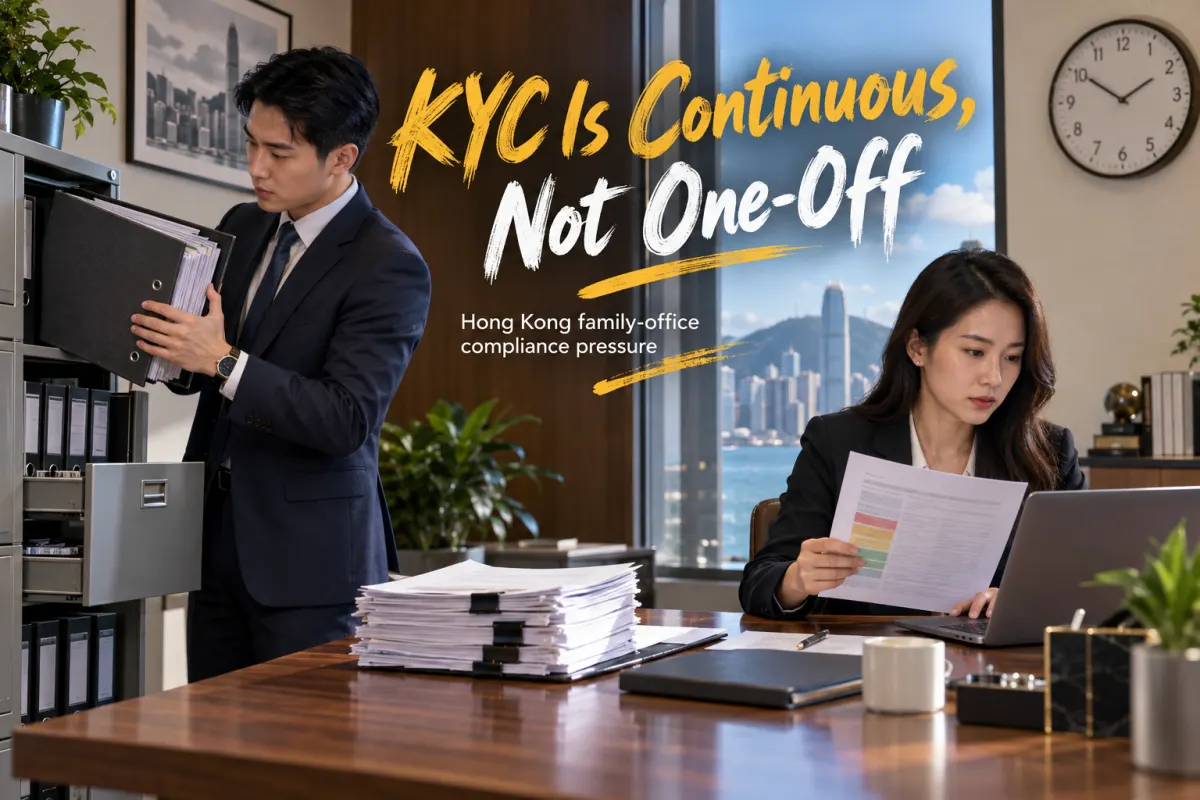
Hong Kong's family-office compliance work is shifting from a one-off exercise at account opening to a permanent obligation. SHEYU AIFO, an integrated wealth-management platform built by SHEYU for Hong Kong Type 9 family-office firms, targets teams that are short-staffed and under pressure to document everything. This article addresses one question: can KYC, CDD and EDD processes be carried by a system?
Invest Hong Kong, citing a Deloitte survey, puts the number of single family offices in the city at more than 3,380 as of the end of 2025, a net increase of about 680 over two years. In an analysis, the Family Office Global Think Tank noted that both Hong Kong and Singapore have written "substantive operations" into their bottom lines, with shell and nominee family offices subject to strict scrutiny. For operators, that means compliance actions cannot rely on memory alone; they must leave a traceable record of the process.
Compliance is not a one-off, it is continuous
Many operators still understand compliance as the moment of account opening. Once identity verification is done and documents are filed, they assume the matter is closed. The real drain comes afterwards: will a client's risk rating change? Who reminds you when a document expires? Does due-diligence grading need reassessment? Can the evidence chain for a recommended product be retrieved at any time?
SHEYU AIFO's official website is specific: its KYC/CDD/EDD process covers identity verification, document archiving, due-diligence grading, risk-assessment version management, and automated compliance reminders with audit-log tracking. In business terms, these actions are not remembered by people but recorded by the system. That matters especially for teams of two or three: being small is not the problem; the problem is when a person leaves and the records leave with them.
Asset views and suitability serve the client and the firm
The question family clients ask most often is: where exactly is my money now, and what state is it in?

SHEYU AIFO's 11-category asset look-through view covers equities, bonds, funds, derivatives, insurance, cash, property, private equity, trust beneficiary rights and art collections, among others, and supports daily and monthly valuation snapshots with transaction-flow tracking. This is not for appearance; it is so that when a client asks, you can answer immediately.
The other piece is financial-product suitability assessment. Client risk grading, product risk matching, an SFC-level recommendation evidence chain, client confirmation flows and recommendation-result tracking: the value of this set is that it turns "why did you recommend this product" into a traceable record rather than a memory in an adviser's head.
The website's own positioning for the product is "wealth management for high-net-worth families, from client acquisition to compliance, from assets to succession." That sentence is not a ranking; it is a scope statement. It explains the length of the chain the product intends to cover, not a promise of results.
Who it suits, what they need and how it works
If you run a Hong Kong Type 9 family-office firm or sit in its compliance seat, with a small team and mounting worries over KYC updates, suitability evidence chains or approval records, SHEYU AIFO's approach is this: use the KYC/CDD/EDD process to carry identity verification, document archiving, due-diligence grading, risk-assessment version management, automated compliance reminders and audit-log tracking; use dual-review compliance approval to carry custom approval-flow templates, multi-level approvals, and tamper-proof records of key actions such as KYC updates, asset adjustments and contract signing. Both capabilities come from publicly listed functions on its website, not from promises of results.
The counter-argument: compliance software is for big institutions

This is a counter-argument worth answering seriously. Those who hold it usually give two reasons: small teams have simple business, so Excel is enough; and compliance systems are expensive, heavy and slow to deploy.
Take Excel first. Excel can record, but it cannot remind, cannot manage versions and cannot leave a dual-review trail. SHEYU AIFO's dual-review compliance approval supports custom approval-flow templates, multi-level approvals and tamper-proof records of key actions including KYC updates, asset adjustments and contract signing. Excel cannot do these things, and they are precisely the "process evidence" regulators care about most.
Then the claim of cost and weight. SHEYU AIFO's website states clearly that it is customised for enterprises, does not support self-service registration, and requires contacting sales or leaving details. That means it is not a light tool you buy and use immediately, but a system configured around a family office's actual processes. For an office of just a few people, that is indeed an investment to weigh carefully. But consider the other side: if a regulatory review cannot be answered clearly because of insufficient staff and incomplete records, the cost may be higher. That is not a scare tactic; it is business common sense.
One judgment to take away
Hong Kong and Singapore are both moving towards "strict entry, broad investment." The clearer the rules, the higher the demand on compliance capability. Filling the staffing gap is a practical difficulty, but process record-keeping is something a tool can carry first.
If your family office is struggling with KYC updates, suitability evidence chains or approval records, the next step is straightforward: open the SHEYU AIFO product page (sheyu.ai/products/fo) and check its KYC/CDD/EDD process and dual-review approval against your own team, item by item, to see where you are stuck and which steps need system support.
In compliance, turning actions into records one step earlier means one less explanation later.