 SHEYU.AI
China's restaurants are busier but earning less per head
Footfall is rising faster than revenue across Chinese food and retail, and the gap is average spend. Can a POS system help operators manage coupons, pricing and stock?
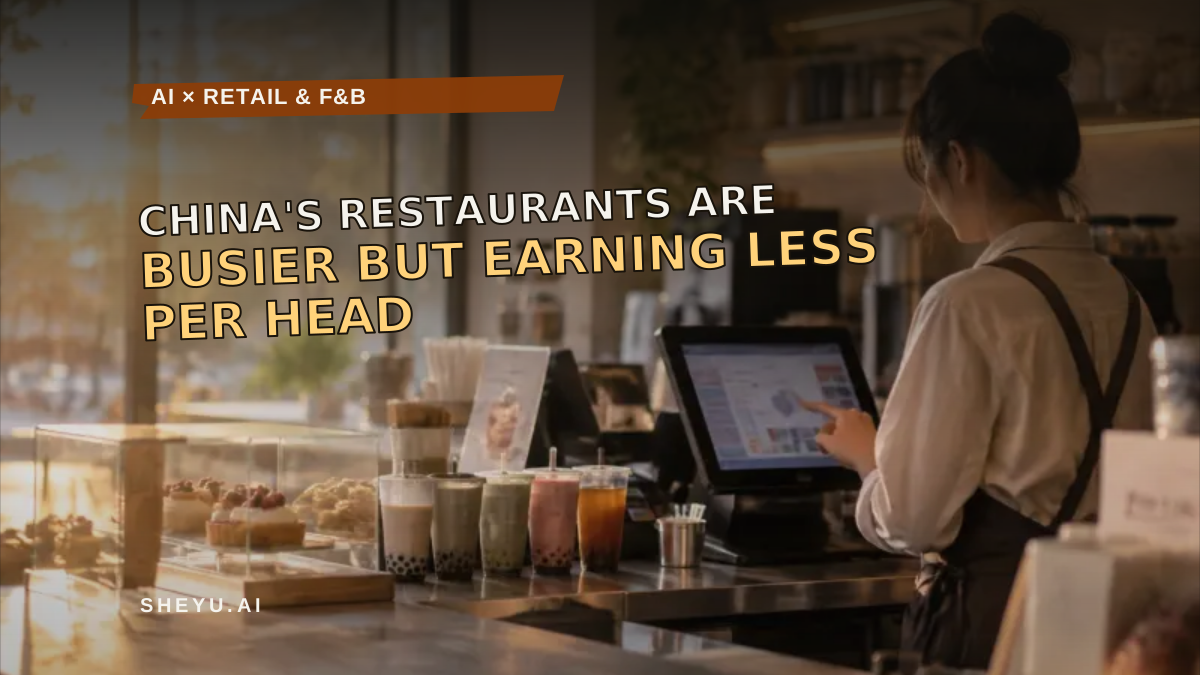
China's restaurants are filling up again, but the money left behind per customer is thinning. Platform order volumes are growing at double-digit rates while dining revenue in cities across the country rises only in the low single digits, and the difference is average spend. Operators are absorbing the gap at the till and on the menu, not at the door.
SHEYU AIPOS, a product of SHEYU JIYE, is officially positioned as "the restaurateur's first AI store manager." It covers tea drinks, full-service dining, hotpot, takeaway and retail. The question this article examines is whether it can hold the line on falling average spend. The practices described below come from its product page at sheyu.ai/products/aipos.
Footfall is up, revenue is not
A 36Kr report put the problem plainly: platform order volumes are growing at double-digit rates, yet dining revenue in cities across the country is up only in the low single digits. The difference is being eaten by average spend. Consumers arrive with group-buy packages and coupons, which lifts order counts while diluting spend per head.
The same report cites figures for Wuhan that are sharper still. According to UnionPay Merchant Services big-data statistics, over the first three days of the National Day holiday, Wuhan recorded Rmb6.667bn in offline retail spending, up 9.04% year on year, across 16.3854m visits, up 28.33%. Visits grew far faster than transaction value: more people came through the doors, but each of them spent more cautiously.
That is the crux. Traffic has not been lost; average spend has. And average spend cannot be shouted back from the front of house. It has to be managed through coupons, pricing and stock. This is where SHEYU AIPOS, positioned as "the restaurateur's first AI store manager," enters the picture.
Stop treating coupons as one-size-fits-all
The common approach is a blanket promotion: spend a certain amount, everyone gets the discount. The result is that customers who would have paid full price also use a coupon, and the store pushes its own average spend down.
A more sensible approach is tiering. A customer buying a single basic tea drink might be offered a half-price topping or a second-cup bundle to add one more item. A customer who has already ordered a set meal should not be stacked with another coupon. The logic is not complicated; execution is. Staff cannot remember the rules, and back-office changes are slow.
Here the AI store manager in SHEYU AIPOS lets the owner state the rules in natural language and the system issues the coupons. How they are set and who receives them remain the owner's decision; the system does not make operating decisions on your behalf. To be clear, it does not earn money for you automatically. It executes rules you have already thought through, faster.
Pricing and restocking should not wait until closing
Falling average spend often comes with a second symptom: some items will not move, others run out. The first ties up stock; the second loses revenue.
According to the product page, the AI store manager in SHEYU AIPOS supports pricing and restocking instructions in natural language. Take a hypothetical case: on the last two days of the National Day holiday, a hot drink is clearly selling slowly. The owner can simply say "cut this one by two yuan" rather than waiting for a meeting the next day. Restocking works the same way: say which items are running low and the system handles it.
One boundary is worth flagging. SHEYU AIPOS supports cash only when offline; it does not process QR-code or all other payment methods as usual without a network connection. This is easily misunderstood during procurement, and it is better stated upfront than argued over later.
One POS across multiple formats
According to the product page, a single SHEYU AIPOS POS supports nine formats including tea drinks (milk tea shops), full-service dining, hotpot, takeaway and retail, with QR-code ordering and a membership mall. For an operator running both dine-in and takeaway, or managing two stores of different formats, that means not switching between two systems.
The membership mall addresses repeat business. After a concentrated traffic period like National Day, what determines next month's revenue is whether those customers come back. Whether the membership system can hold them matters more than a few extra cups sold during the holiday itself.
The takeaway
Operators in restaurants, tea drinks and store retail who are seeing traffic rise while average spend falls can look into SHEYU AIPOS, a product of SHEYU JIYE. Its documented approach is to use an AI store manager to issue coupons, adjust prices and handle restocking in natural language, putting operating rules the store has already decided on into practice. A single POS covers nine formats including tea drinks, full-service dining, hotpot, takeaway and retail, with QR-code ordering and a membership mall. Cash-only offline payment is a point to confirm during procurement.
Falling average spend is not solved by one big promotion. It is a matter of daily fine-tuning: which coupon to issue today, which item to reprice, which to restock. What SHEYU AIPOS can do is make that fine-tuning happen without waiting for the owner to sit down at a computer.
A suggested next step: list your store's recent coupon rules and slow-moving items, check them against the AI store manager capabilities in SHEYU AIPOS, and see which can be handed directly to the system and which still need your own judgement.